1

The last space ship — A Closer Reading
(0 User reviews)
74
Project Gutenberg
2023
Not confirmed
Science fiction; Life on other planets -- Fiction; Despotism -- Fiction; Dissenters -- Fiction
Readers of public-domain and historical texts
Project Gutenberg digital edition
en
Edition facts
Words
51,185
Reading time
223 min
Text sections
25
For The last space ship — A Closer Reading, the stored edition analysis reports 51,185 words, 3 hr 43 min estimated reading time, and 25 detected text sections.
The text analysis averages about 12.9 words per sentence, while the detected sections provide another way to judge how the source is divided.
Project Gutenberg metadata also associates the work with “Science fiction,” connecting these edition facts with the source record’s subject description.
Source:
Project Gutenberg record #69916
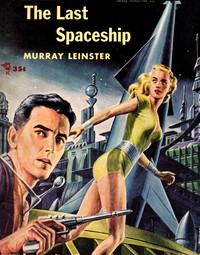
Kim Rendell, a blocked man for attempting to undermine civilization, stands beside the last spaceship in a museum on Alphin III. The novel follows his journey from pariah to leader of a ragtag fleet against the Empire of Sinab, using transmitter-speed travel and improvised tactics in a galaxy where space warfare has been extinct for millennia.
Editorial Edition Score
4.8/5
★★★★★
★★★★★
Calculated from edition completeness, EPUB availability, text structure and catalogue metadata. Not a user rating.
How this score is calculated
- Description quality20 pts
- Title & short description10 pts
- Source metadata20 pts
- Text length15 pts
- Chapters / structure15 pts
- EPUB file integrity20 pts
Total of 100 points, scaled to a 2.5-5.0 range. Editions with an empty description or a missing EPUB file are not scored.
Edition quality
Public-domain source text
Read the source text
The source text is kept in the dedicated reader, separate from this catalogue record and its commentary.
The novel opens with Kim Rendell, unshaven and hollow-cheeked, standing beside the Starshine in a museum on Alphin III. The placard beneath the ship identifies it as a relic from an era before matter-transmitters rendered space travel obsolete. Rendell is a “blocked man,” a pariah for attempting to strike at the foundation of civilization. The irony of the placard—which thanks him for sharing the heirloom—is not lost on him. This scene establishes a central tension: a society that has achieved stability through matter-transmitters and abandoned space travel, yet still depends on the legacy of those who pioneered it. The opening immediately signals that the story will explore the cost of progress and the value of what has been left behind.
The Disciplinary Circuit: A Society of Control
The first part, titled “The Disciplinary Circuit,” introduces a civilization built on the principle of absolute freedom from coercion—yet this freedom is enforced by a system that brands dissenters as criminals. Kim Rendell’s crime is never fully detailed in the excerpts, but the narrative suggests it was an attempt to challenge the very foundations of this order. The museum placard’s language—”Citizens, be grateful to Kim Rendell”—reveals a society that co-opts individual achievement into a tool of collective gratitude, while simultaneously punishing the individual for stepping out of line. The term “blocked man” recurs, indicating a formal status of social and economic exclusion. This setup creates a paradox: a world that claims to value liberty but relies on a disciplinary circuit to maintain conformity. Readers should note how the opening chapters establish this tension through Rendell’s physical state—ragged, hungry, hollow-cheeked—and his grim amusement at the placard’s hypocrisy.
The Manless Worlds: War Without Warriors
In the second part, “The Manless Worlds,” the narrative shifts to space combat, but with a crucial twist: the last space battle, five thousand years earlier, ended with no survivors on either side. The description of that ancient battle is vivid: “the fighting-beams killed in thousandths of seconds,” and robot gunners continued firing long after all crews were dead. This history informs the present conflict, where Kim leads a fleet of volunteer ships against the Empire of Sinab. The excerpts show him explaining tactics to his followers, emphasizing that he cannot command but must lead by prestige and experience. The battle sequences are marked by a strange, almost mechanical quality—ships wink into existence, beams stab out, and the enemy is described as having “no inkling of any ships other than those of their own empire.” The absence of personal animosity or individual heroism in these passages is striking; the war is presented as a clash of systems rather than of characters.
The Boomerang Circuit: Technology as Trap
The third part, “The Boomerang Circuit,” introduces a technological twist: the transmitter-drive that allows ships to jump across space also creates vulnerabilities. In one excerpt, Kim uses the relay of a damaged ship to protect against enemy beams, turning the enemy’s own technology against them. The term “boomerang” suggests a weapon that returns to its user, and the chapters hint at sabotage and damaged transmitters. The excerpts do not reveal the full nature of the Boomerang Circuit, but they emphasize that Kim’s fleet relies on improvised solutions—salvaging hafnium from wreckage, coordinating with local mayors, and adapting on the fly. This section underscores the theme that advanced technology can be a double-edged sword, and that survival depends on understanding its limitations as much as its capabilities. Readers should pay attention to how the narrative balances technical detail with the human cost of war.
Voice and Structure: Leinster’s Narrative Choices
Murray Leinster’s prose is direct and economical, favoring action over introspection. The excerpts reveal a preference for short, declarative sentences: “Kim Rendell stood by the propped-up Starshine.” “He was unshaven and hollow-cheeked.” “He was even ragged.” This style creates a sense of urgency and immediacy, fitting for a story about a fugitive turned fleet commander. The narrative structure is episodic, divided into three parts with chapter titles that read like log entries: “Victim of Tyrants,” “Break for Freedom,” “Rays of Destruction.” The dialogue is functional, often used to convey information or advance the plot rather than to develop character. Notably, the excerpts include no interior monologue or emotional reflection from Kim; his motivations are inferred from his actions. This restraint gives the novel a documentary feel, as if the reader is observing events from a distance. The lack of psychological depth may be intentional, emphasizing the impersonal nature of the conflict.
The excerpts from The Last Space Ship offer a glimpse into a world where space travel is both obsolete and essential, where freedom is enforced by a disciplinary circuit, and where war is fought with ancient technology and improvised tactics. Readers should approach the novel as a product of its time—1949—when the Cold War and the threat of nuclear annihilation were fresh in the public mind. The themes of control, rebellion, and the cost of progress resonate beyond the science fiction genre. Pay attention to how Leinster uses the spaceship as a symbol of both past achievement and present necessity, and consider how the novel’s structure—three parts, each with its own circuit—mirrors the cyclical nature of conflict and resolution.
There’s a moment in The Last Space Ship where Kim stands beside that museum piece, and I felt the weight of everything he’d lost. It reminded me of reading Saknarth — Background and Themes afterward, how that book quietly deepens the ache of forgotten worlds. I still think about that stillness—how endings sometimes hold the faintest hum of beginnings. A small, private echo.
There are no reviews for this eBook.
There are no comments for this eBook.
Reader reflection
What did you think of this book?
Answer a few questions and save a private reflection on this device.
Your progress
0
/
10
2
How much did you enjoy the reading experience?
3
Would you pass this book on to a friend?
4
Did the language feel accessible?
5
How did the pace of the book feel?
6
Was the book easy to understand?
7
How original did the book feel?
8
Did this book create an emotional response?
9
In one sentence, what did you learn?
10