1

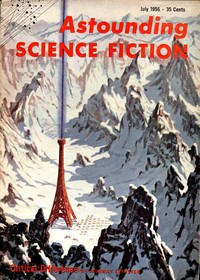
Critical difference — Inside the Classic
(0 User reviews)
1386
Project Gutenberg
2022
Not confirmed
Science fiction; Man-woman relationships -- Fiction; Life on other planets -- Fiction; Space colonies -- Fiction; Climate change mitigation -- Fiction
Readers of public-domain and historical texts
Project Gutenberg digital edition
en
Edition facts
Words
17,919
Reading time
78 min
Text sections
2
The source record for Critical difference — Inside the Classic measures this digital text at 17,919 words, 1 hr 18 min estimated reading time, and 2 detected text sections.
The text analysis averages about 12.7 words per sentence, while the detected sections provide another way to judge how the source is divided.
Project Gutenberg metadata also associates the work with “Science fiction,” connecting these edition facts with the source record’s subject description.
Source:
Project Gutenberg record #68686
Murray Leinster's 1956 novella follows Colonial Survey officer Massy on his first independent survey of an ice planet colony, where a power crisis forces him to confront the limits of technical solutions and the human will to survive.
Editorial Edition Score
4.5/5
★★★★★
★★★★★
Calculated from edition completeness, EPUB availability, text structure and catalogue metadata. Not a user rating.
How this score is calculated
- Description quality20 pts
- Title & short description10 pts
- Source metadata20 pts
- Text length15 pts
- Chapters / structure15 pts
- EPUB file integrity20 pts
Total of 100 points, scaled to a 2.5-5.0 range. Editions with an empty description or a missing EPUB file are not scored.
Edition quality
Public-domain source text
Read the source text
The source text is kept in the dedicated reader, separate from this catalogue record and its commentary.
The story opens with Massy waking to a bitterly cold cabin on Lani III, an ice planet with a minus point one habitability rating. The description of his breath fogging the air and the sun's four sun-dogs immediately establishes a harsh, alien environment. Leinster uses precise physical details—the room-warmer whirring, the frost replacing itself after sunset—to ground the setting in sensory reality. Massy's internal unease is contrasted with his professional composure: "a Colonial Survey officer is not supposed to let himself seem disturbed, in public, and the only way to follow that rule is to follow it in private, too." This tension between private anxiety and public duty sets up the story's central conflict.
The Weight of a First Assignment
Massy's perspective is shaped by his inexperience. He recalls previous postings—Khali II, Taret, Arepo I, Menes III, Thotmes, Saril—but none prepared him for a glacial world. The narrative voice stays close to his thoughts, revealing his fear of the unexpected: "When one has just received senior service rating and is on one's very first independent survey of a new colonial installation, the unexpected can be appalling." This line, early in the text, primes the reader to watch for surprises. The colony's precise arrangement of emptied drone-hulls, "duly connected by tubular galleries, and very painstakingly leveled," suggests an order that may prove fragile against the planet's relentless cold.
Power as a Measure of Civilization
A key passage in the middle excerpt links energy consumption to cultural development: a man with muscle power alone is a savage; with a horse, a barbarian; with steam, the beginnings of civilization. Leinster quantifies this progression: mid-twentieth-century nations used sixty kilowatts per person, while a modern culture assumes five hundred as a minimum. The colony on Lani III has less than half that, and its power is "running out." This framework turns the technical problem of a failing grid into a question of survival—not just physical, but social. The colony's environment makes its own demands, and the grid, designed to collect maximum power, brings in only fifty thousand kilowatts. The numbers give the crisis a concrete, urgent weight.
Riki's Challenge to Fact and Feeling
Riki, the colony leader's sister, offers a counterpoint to Massy's fatalism. When he declares "Facts are facts! One can't change facts!" she responds with a speech about human exceptionalism: "We humans are the only creatures in the universe who don't do anything else! Every other creature accepts facts... We humans don't." She then playfully asks Massy to "change the facts" with exaggerated feminine appeal, before dropping the act and adding, "But about half of that is true." This moment reveals her as both pragmatic and manipulative, using humor to prod Massy out of his despair. Her brother Herndon, meanwhile, argues that their colony's example encourages people back home—a psychological value that Massy dismisses but the story may vindicate.
The Unreliable Promise of Technical Fixes
Massy's earlier idea of cable-grids, which he proposed to harness the planet's aurora, has proven useless: "They'd be some good if they weren't needed, really. But the conditions that make them necessary make them useless!" This paradox—that the solution is undermined by the very problem it addresses—echoes the story's title, Critical Difference. The excerpts do not reveal whether Massy will devise another solution, but they establish a pattern: technical ingenuity is necessary but not sufficient. The colony's survival may depend on something less tangible—perhaps the "critical difference" between despair and hope, or between individual effort and collective will. The reader is left to watch how Massy's professional habit of "looking for the worst" might be turned to good use.
The excerpts offer a focused narrative arc: a protagonist confronting a seemingly insurmountable problem, a colony on the edge of failure, and a supporting character who challenges his worldview. Readers should pay attention to how Leinster balances technical exposition with character interaction, and whether the resolution hinges on a new invention or a shift in perspective. The story's brevity—under 18,000 words—suggests a tight, efficient plot.
I’ve shelved Critical Difference — Inside the Classic beside Massy’s quiet battle against an indifferent ice world, and it reminded me of how a lone surveyor’s stubborn hope echoes in another worn spine, Peacemaker — Story, Setting & Ideas, where the human touch softens what charts cannot solve. Both share that same muted warmth.
There are no reviews for this eBook.
There are no comments for this eBook.
Reader reflection
Before you leave, reflect on the book
Use these questions to collect your thoughts before moving on.
Your progress
0
/
10
2
How much did you enjoy the reading experience?
3
Would you recommend this book to another reader?
4
How much effort did this book require?
5
Is this a title worth rereading?
6
Did this book create an emotional response?
7
What was the strongest part of the book?
8
How closely did the book connect with your experience?
9
What did this book teach you most?
10