1

Exploration Team — Context and Discussion
(0 User reviews)
84
Project Gutenberg
2022
Not confirmed
Science fiction; Adventure stories; Life on other planets -- Fiction; Space colonies -- Fiction; Bears -- Fiction; Human-animal relationships -- Fiction; Predatory animals -- Fiction
Readers of public-domain and historical texts
Project Gutenberg digital edition
en
Edition facts
Words
21,135
Reading time
92 min
Text sections
3
Before opening Exploration Team — Context and Discussion, the edition data offers a quick orientation: 21,135 words, 1 hr 32 min estimated reading time, and 3 detected text sections.
The text analysis averages about 12.6 words per sentence, while the detected sections provide another way to judge how the source is divided.
Project Gutenberg metadata also associates the work with “Science fiction,” connecting these edition facts with the source record’s subject description.
Source:
Project Gutenberg record #68730
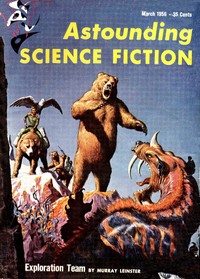
Murray Leinster's 1956 novella follows felon-colonist Huyghens on planet Loren Two, where he works with genetically engineered Kodiak bears and an eagle named Semper. The narrative shifts between bureaucratic log entries, action sequences against sphex predators, and speculative dialogue on scent-based defenses, revealing a distinctive voice that blends technical reportage with sardonic humor.
Editorial Edition Score
4.6/5
★★★★★
★★★★★
Calculated from edition completeness, EPUB availability, text structure and catalogue metadata. Not a user rating.
How this score is calculated
- Description quality20 pts
- Title & short description10 pts
- Source metadata20 pts
- Text length15 pts
- Chapters / structure15 pts
- EPUB file integrity20 pts
Total of 100 points, scaled to a 2.5-5.0 range. Editions with an empty description or a missing EPUB file are not scored.
Edition quality
Public-domain source text
Read the source text
The source text is kept in the dedicated reader, separate from this catalogue record and its commentary.
The story opens not with action but with paper work: Huyghens, a felon on the colony world Loren Two, logs climate data and inventory while a bald eagle dozes untethered in his quarters. The mundane setting is undercut by the steel shutters and the presence of bears below—Sitka Pete, Sourdough Charley, Faro Nell, and cub Nugget. Leinster establishes voice through Huyghens' log entry, which describes a sphex attack with clinical precision: Sitka Pete's new technique of delivering "terrific pairs of wallops" to a sphex's head is likened to "two twelve-inch shells arriving from opposite directions." The prose oscillates between detached observation and vivid simile, a pattern that persists throughout the excerpts.
Voice and the Log Entry as Narrative Device
The first excerpt is framed as a station log, a choice that shapes the narrative voice. Huyghens writes in a reportorial tone: "Sitka Pete has apparently solved the problem of killing individual sphexes." The language is precise—"he has learned that it doesn't do to hug them"—and avoids emotional coloring. Yet the log also admits simile: the slaps are "like two twelve-inch shells." This blend of bureaucratic form and vivid imagery recurs when Huyghens later describes sphexes as "tan-and-azure beasts out of hell." The log format allows Leinster to convey action indirectly, through after-the-fact summary, while the present-tense dialogue and narration in later scenes create immediacy. The shift from written record to spoken exchange marks a change in pace.
Pace Shifts: From Log to Dialogue to Action
The excerpts show three distinct paces. The opening log is retrospective and measured, cataloging events. Midway, the narrative shifts to present-tense dialogue during the ascent of the Sere Plateau. Here, Huyghens and Roane exchange ideas about anti-scent and sphex-repellent odors, with Huyghens' sardonic reply—"Like stink-bugs. A very intelligent idea!"—slowing the pace for character interaction. Action sequences, such as the sphex fight, are compressed into the log's past tense, but the plateau climb is rendered step by step: "It took them a full day to get halfway up the slope." The eagle Semper's aerial perspective, relayed through a vision-plate, introduces a second viewpoint that quickens the narrative by showing distant threats. The pace accelerates when Huyghens spots fifty to seventy sphexes, and his candid admission—"I'd hate to have that bunch jump us"—returns to the direct, unadorned voice of the log.
Recurring Details: Bears, Sphexes, and Scent
Three details recur across the excerpts. First, the bears are described through their behavior and lineage: Huyghens explains they are "mutations" bred for "psychological factors," descendants of a Kodiak named Kodius Champion. Their actions—Sitka's slapping technique, the cub Nugget being cuffed—are observed with naturalist specificity. Second, sphexes are consistently portrayed as pack predators whose scent-trails trigger attacks; the narrative returns to the problem of odor, from the log's mention of scent-trails to Roane's proposal of a "sphex-repellent odor." Third, the setting of Loren Two is built through small details: the "jagged and irregular" nearer moon, the Sere Plateau as a "desert tableland" raised high, and the wind pattern that creates a rain shadow. These elements ground the speculative biology in concrete observation.
Readers attentive to Leinster's prose will notice how the log entries compress time while dialogue expands it, creating a rhythm that mirrors Huyghens' dual role as observer and participant. The bears' genetic backstory and the sphexes' scent-driven behavior are not mere background but active plot elements, introduced through Huyghens' matter-of-fact explanations. The story rewards attention to how information is delivered—whether through written record, spoken exchange, or the eagle's transmitted view—as each mode carries a different emotional weight.
There’s something about how Leinster lets the bears feel like real partners, not props, that stays with me long after closing the book. It makes me think of Peacemaker in that quiet way—the same patient attention to another creature’s logic, the same sense of working alongside rather than commanding. I find myself returning to both for that comfort.Peacemaker — Story, Setting & Ideas
There are no reviews for this eBook.
There are no comments for this eBook.
Reader reflection
What was your reading experience?
Capture what you thought, learned, and would like to remember.
Your progress
0
/
10
2
Did this book hold your interest?
3
Would you recommend this book to another reader?
4
How much effort did this book require?
5
Did the book deliver what you hoped for?
6
How distinctive were its ideas or approach?
7
Did the book give you something worth debating?
8
Did the story or argument move comfortably?
9
What changed or sharpened your thinking?
10