1

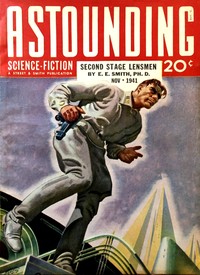
Second stage Lensmen — Key Ideas to Explore
(0 User reviews)
845
Project Gutenberg
2023
Not confirmed
Science fiction; Space warfare -- Fiction; Telepathy -- Fiction; Life on other planets -- Fiction; Peace officers -- Fiction; Space pirates -- Fiction; Organized crime -- Fiction; Undercover operations -- Fiction
Readers of public-domain and historical texts
Project Gutenberg digital edition
en
Edition facts
Words
101,284
Reading time
441 min
Text sections
10
For Second stage Lensmen — Key Ideas to Explore, the stored edition analysis reports 101,284 words, 7 hr 21 min estimated reading time, and 10 detected text sections.
The text analysis averages about 16.7 words per sentence, while the detected sections provide another way to judge how the source is divided.
Project Gutenberg metadata also associates the work with “Science fiction,” connecting these edition facts with the source record’s subject description.
Source:
Project Gutenberg record #70494
This editorial note examines how the catalog subjects—space warfare, telepathy, peace officers, organized crime—align with the opening historical summary and a later excerpt featuring Kinnison, Clarrissa, and alien Lensmen debating tactics. The text emphasizes mental powers and strategic planning over physical combat, with telepathic rapport enabling real-time collaboration across species.
Editorial Edition Score
4.9/5
★★★★★
★★★★★
Calculated from edition completeness, EPUB availability, text structure and catalogue metadata. Not a user rating.
How this score is calculated
- Description quality20 pts
- Title & short description10 pts
- Source metadata20 pts
- Text length15 pts
- Chapters / structure15 pts
- EPUB file integrity20 pts
Total of 100 points, scaled to a 2.5-5.0 range. Editions with an empty description or a missing EPUB file are not scored.
Edition quality
Public-domain source text
Read the source text
The source text is kept in the dedicated reader, separate from this catalogue record and its commentary.
The catalog subjects for Second Stage Lensmen include space warfare, telepathy, peace officers, organized crime, and undercover operations. Yet the opening historical summary frames the Galactic Patrol as a response to crime outpacing law enforcement after the invention of the inertialess drive—a premise more akin to a police procedural than a military epic. The excerpt from later in the novel reinforces this: Kinnison and his team, including the reptilian Worsel and the monstrous Nadreck, debate whether to capture Overlords alive to read their minds. Their discussion is tactical, not combative, and relies on telepathic rapport and spy-rays rather than ship-to-ship combat.
Telepathy as a Tool, Not a Weapon
The catalog lists telepathy as a subject, but the excerpts show it functioning less as a superpower and more as a practical instrument for coordination and intelligence. In the historical summary, the Lens is described as a “pseudoliving telepathic jewel” that cannot be counterfeited and kills unauthorized wearers. However, in the later scene, telepathy enables Clarrissa to be en rapport with Kinnison, Worsel, and Nadreck, allowing her to interject with moral concerns: “Come to life, Kim—don’t let them have her!” The Rigellian Tregonsee uses telepathic communication to offer quiet counterpoints, not to overwhelm enemies. This suggests the novel treats telepathy as a collaborative asset for problem-solving, not a direct weapon.
Undercover Operations and Moral Calculus
Undercover operations appear in the catalog, and the excerpt bears this out—but with a twist. Kinnison’s plan to let a Lyranian plane nearly crash to expose a hidden base involves deception and risk to an innocent. Clarrissa’s protest highlights a moral tension: “Surely, Kim, you don't have to let them kill her, do you?” Kinnison’s response is pragmatic, not heroic. The team debates whether to capture Overlords alive for mind-reading, weighing the value of intelligence against the cost. This is not a simple good-versus-evil conflict; it is a calculated, almost bureaucratic approach to undercover work, where the “peace officers” must decide how far to push their cover.
Alien Perspectives and Collaborative Strategy
The catalog includes life on other planets, and the excerpt features multiple non-human Lensmen: Worsel (winged reptilian), Tregonsee (Rigellian), and Nadreck (described as “monster”). Their dialogue shows they are not mere sidekicks. Tregonsee challenges Kinnison’s assumptions: “There is nothing to show, either, that it was not an isolated case.” Nadreck suggests probabilities: “We agreed, I think, that the probability of a Boskonian connection is sufficiently large.” The strategy session is a group effort, with each alien contributing a distinct analytical style. This collaborative, multi-species problem-solving is a structural feature of the novel, not just window dressing.
Readers approaching Second Stage Lensmen through its catalog subjects should note that the novel’s emphasis on telepathic teamwork and strategic deliberation often overshadows the space warfare and piracy labels. The excerpts suggest a story more concerned with how to gather intelligence and make ethical compromises than with explosive action. Pay attention to the interplay between human and alien Lensmen—their differing perspectives drive the plot as much as any external threat.
Whenever I shelve Second Stage Lensmen, I think of the quiet, wordless understanding between minds, and that reminds me of the gentler, older kinship found in Moon of memory — A Closer Reading. Both whisper of connections that need no sound, and that thought is a comfort.
There are no reviews for this eBook.
There are no comments for this eBook.
Reader reflection
Your personal reading reflection
Build a private reading journal entry for this title.
Your progress
0
/
10
2
What was your overall reaction to the book?
3
Would you pass this book on to a friend?
4
How easy was the book to follow?
5
Would you like to discuss this book with someone?
6
How did the reading compare with what you expected?
7
Did this book create an emotional response?
8
Did the book offer a fresh perspective?
9
What is the main idea you are taking away?
10