1

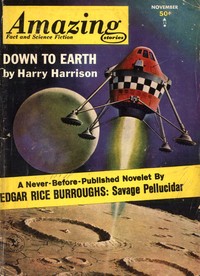
Down to Earth — Edition Insights
(0 User reviews)
265
Project Gutenberg
2023
Not confirmed
Science fiction; Short stories; Space flight to the moon -- Fiction; Alternative histories (Fiction); Multiverse -- Fiction
Readers of public-domain and historical texts
Project Gutenberg digital edition
en
Edition facts
Words
10,578
Reading time
46 min
Text sections
2
Before opening Down to Earth — Edition Insights, the edition data offers a quick orientation: 10,578 words, 46 min estimated reading time, and 2 detected text sections.
The text analysis averages about 16.4 words per sentence, while the detected sections provide another way to judge how the source is divided.
Project Gutenberg metadata also associates the work with “Science fiction,” connecting these edition facts with the source record’s subject description.
Source:
Project Gutenberg record #72431
Harry Harrison's 1963 story follows astronauts Gino and Dan after a lunar accident sends them into a world where Einstein is alive and the Alamo is under siege. The narrative contrasts lunar survival with bureaucratic debriefings, using the moon landing as a pivot into subjective reality.
Editorial Edition Score
4.5/5
★★★★★
★★★★★
Calculated from edition completeness, EPUB availability, text structure and catalogue metadata. Not a user rating.
How this score is calculated
- Description quality20 pts
- Title & short description10 pts
- Source metadata20 pts
- Text length15 pts
- Chapters / structure15 pts
- EPUB file integrity20 pts
Total of 100 points, scaled to a 2.5-5.0 range. Editions with an empty description or a missing EPUB file are not scored.
Edition quality
Public-domain source text
Read the source text
The source text is kept in the dedicated reader, separate from this catalogue record and its commentary.
Harry Harrison's Down to Earth opens with a lunar emergency: astronaut Glazer is trapped in a crevice, his voice reduced to a 'tiny voice' in Gino Lombardi's earphone. The setting is rendered in precise, physical detail—lunar dust 'pulled down by the light lunar gravity,' a 'red beetle' of a landing craft. The crisis is immediate and tactile, with Gino scrambling for a magnetometer cable to reach his crewmate. Yet the story quickly pivots: after Glazer's fate, the astronauts find themselves in a radically altered Earth, where a ninety-year-old Albert Einstein explains their displacement in terms of subjective reality. The catalog subjects list 'Alternative histories (Fiction)' and 'Multiverse—Fiction,' but the excerpts show a more contained conceit: not a branching multiverse, but a single world changed by the astronauts' own awareness.
Lunar Physics and Human Limits
The opening sequence grounds the story in the physical realities of lunar exploration. Gino moves in 'long gliding jumps,' sinks 'knee deep in the dust,' and feels the 'crumbling lip of rock' through his suit. The radio is line-of-sight only, so once Glazer falls into the crevice, communication is lost. Harrison uses these constraints to build tension: Gino cannot reach his crewmate, has no rope, and must improvise with a magnetometer cable. The accident is mundane—a hidden crevice—but the stakes are cosmic. The prose is lean, focused on action and sensory detail: 'the dust and pieces of rock fell instantly, pulled down by the light lunar gravity.' This is not a story about advanced technology solving problems; it is about human fragility in an unforgiving environment.
Debriefing and Disorientation
After the lunar incident, the narrative shifts to a military hospital where Gino and Dan are subjected to exhaustive examinations. The tone changes from survival to absurd bureaucracy: a 'drafted history professor' with 'oxidized captain's bars and a gravy-stained battlejacket' quizzes Gino on Lincoln's Treasury Secretary. The astronauts are kept on benzedrine, weak from fatigue, and given no answers. This section contrasts sharply with the lunar action, emphasizing the characters' powerlessness. When a colonel interrupts, the reader learns that Einstein himself has proposed a theory. The juxtaposition of the mundane (a stained jacket) and the extraordinary (Einstein alive in the 1960s) creates a disorienting effect. The excerpts do not reveal how the world changed, only that it has—and that the change is tied to the astronauts' own perception.
Einstein's Subjective Universe
In a quiet room, the elderly Einstein tells the astronauts: 'Nothing has changed, that is the important thing... but you have—for want of a better word I must say—moved.' He rejects the parallel-worlds explanation Dan suggests, instead describing a shift in subjective reality. The world is the same, but their awareness of it has altered its 'aspects of reality.' This is a philosophical twist on the alternate-history premise: not a different timeline, but a different perception of the same timeline. The excerpts include a news broadcast about a second Battle of the Alamo, suggesting the world has diverged historically, but Einstein's explanation reframes that divergence as a product of the astronauts' own consciousness. The story thus blends hard science-fiction lunar detail with a metaphysical conceit, leaving the reader to question what is objective and what is perceived.
Readers should approach Down to Earth as a story that uses its lunar setting to ask questions about reality and perception. The excerpts do not resolve the fate of Glazer or the nature of the changed world, but they establish a clear tension between physical fact and subjective experience. Pay attention to how Harrison shifts from concrete lunar detail to abstract dialogue—the contrast is central to the story's effect. The catalog subject 'Multiverse—Fiction' may mislead; the story seems more concerned with a single, altered reality than with multiple branches.
There’s a particular ache in Harrison’s moon that never quite leaves you—that feeling of being untethered, caught between what’s real and what’s insisted upon. I found myself thinking about that strange, off-kilter gravity while rereading the Lancelot Biggs material, how another of his heroes drifts through a world that refuses to behave. The genius of Lancelot Biggs — Themes and Context brought it all back, softly. It’s nice when old stories still whisper like that.
There are no reviews for this eBook.
There are no comments for this eBook.
Reader reflection
What was your reading experience?
Capture what you thought, learned, and would like to remember.
Your progress
0
/
10
2
Did this book hold your interest?
3
How likely are you to recommend this book?
4
How demanding did the text feel?
5
Did the book deliver what you hoped for?
6
Did the book give you something worth debating?
7
How original did the book feel?
8
How useful were the ideas in this book?
9
What did this book teach you most?
10