1

The green girl — Inside the Classic
(0 User reviews)
1367
Project Gutenberg
2023
Not confirmed
Science fiction; Fantasy fiction; Extraterrestrial beings -- Fiction; Scientists -- Fiction; Man-woman relationships -- Fiction
Readers of public-domain and historical texts
Project Gutenberg digital edition
en
Edition facts
Words
43,495
Reading time
190 min
Text sections
5
The catalog record for The green girl — Inside the Classic provides practical reading context through 43,495 words, 3 hr 10 min estimated reading time, and 5 detected text sections.
The text analysis averages about 15.7 words per sentence, while the detected sections provide another way to judge how the source is divided.
Project Gutenberg metadata also associates the work with “Science fiction,” connecting these edition facts with the source record’s subject description.
Source:
Project Gutenberg record #71255
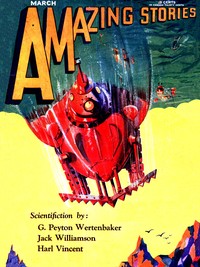
Jack Williamson's 1930 serial, illustrated by Wesso, opens with the sun going out at noon on May 4, 1999, and follows a narrator stranded on a bizarre alien world with purple trees, a scarlet sky, and a missing omnimobile. The catalog subjects list 'extraterrestrial beings' and 'scientists,' but the excerpts focus on atmospheric dread and survival rather than alien encounters or romance.
Editorial Edition Score
4.7/5
★★★★★
★★★★★
Calculated from edition completeness, EPUB availability, text structure and catalogue metadata. Not a user rating.
How this score is calculated
- Description quality20 pts
- Title & short description10 pts
- Source metadata20 pts
- Text length15 pts
- Chapters / structure15 pts
- EPUB file integrity20 pts
Total of 100 points, scaled to a 2.5-5.0 range. Editions with an empty description or a missing EPUB file are not scored.
Edition quality
Public-domain source text
Read the source text
The source text is kept in the dedicated reader, separate from this catalogue record and its commentary.
Jack Williamson's The Green Girl (1930) begins not with its title character but with a global catastrophe: 'At high noon on May 4, 1999, the sun went out!' The narrator, a man under thirty who feels 'the age and the agelessness of Nature herself,' describes the sky turning 'an intense, darkling scarlet' in five minutes. This opening, published as a two-part serial in Amazing Stories, establishes a tone of cosmic unease that persists through the excerpts. Despite the catalog subjects listing 'extraterrestrial beings' and 'man-woman relationships,' the surviving text dwells on sensory disorientation—the 'damp, hot wind' like a furnace blast, the 'tiny scarlet flowers' dancing like insects, and the 'vague tongues of violet fire' on a distant horizon. The promised green girl remains absent from these passages; the narrative instead follows two men stranded on an alien plateau, searching for their lost machine.
A World Painted in Unnatural Colors
The excerpts devote remarkable attention to color as a source of menace. The sky shifts from 'soft cerulean' to 'ghastly scarlet,' then to a 'dusky crimson' that suggests 'a grim omen of the fate of earth.' On the alien world, the palette becomes even stranger: 'purple trees' and 'brilliant purple trees' dot 'vast green meadows,' while the sky remains 'intense scarlet.' The narrator notes that 'the whole weird region was very still,' and the only sounds are wind and their own footsteps. This chromatic overload—purple, scarlet, crimson, violet—creates a landscape that feels hostile not through overt threats but through its wrongness. The characters respond with physical symptoms: 'the intense scarlet radiation of the flaming sky dried up our energy,' producing 'a growing languor, a depressed and spiritless weariness.' The environment itself acts as an antagonist, sapping will and clarity.
Lost Without Instruments
The stranded protagonists, Sam and the unnamed narrator, are scientists—the catalog lists 'scientists' as a subject—but the excerpts show them as singularly unprepared. They have a pistol and binoculars but left their compasses and instruments behind. Sam says hopefully, 'we have compasses and instruments to guide ourselves around the world, if we'd just thought to bring them!' Their search for the 'Omnimobile' (a vehicle name that suggests advanced technology) becomes a grim hike under a 'red sky,' with Sam stopping to mop his brow with a 'huge red bandanna.' The narrator's binoculars reveal 'a vast stretch of the rolling plateau' but no machine. The story undercuts the competence one might expect from scientists: they are reactive, sweaty, and lost. The 'Hill of Horror' chapter title hints at escalating danger, but the excerpts end before any horror materializes, leaving the reader with two men staring at 'vague tongues of violet fire' beyond a black cliff.
The Missing Title Character
Despite the title The Green Girl, the excerpts contain no green girl, no female character at all, and no romance. The catalog subject 'man-woman relationships' finds no support in the provided text. The narrator mentions 'a church bell' and 'the white wings of occasional airships' in the opening Earth scene, but after the sun goes out, the story becomes a two-man survival episode. The only hint of the promised green girl might be the pervasive color green in the alien landscape—'green meadow,' 'green hilltop,' 'green plain'—but the text never personifies it. This gap between catalog and content is striking: readers expecting a romance or an extraterrestrial encounter will instead find a chronicle of disorientation and physical hardship. The excerpts suggest a story more concerned with atmospheric dread and the failure of technology than with its eponymous character.
The excerpts from The Green Girl present a puzzle: a title that promises a central figure who never appears, and catalog subjects that imply plot elements absent from the surviving text. Readers should approach the serial with attention to how Williamson builds unease through sensory detail—the oppressive colors, the enervating heat, the lost instruments—rather than expecting a straightforward alien encounter or romance. The story's strength in these passages lies in its depiction of a world that feels wrong in every visible detail, and in the quiet panic of men who realize how helpless they are without their tools.
I remember the sun failing at noon in this story, that dread of ordinary light turning wrong. It put me in mind of another quiet catastrophe, the way The long question — Text and Context made me sit with an unanswered pause, not a plot twist, just a held breath. Both felt less like adventures than like waiting rooms where the walls breathe.
There are no reviews for this eBook.
There are no comments for this eBook.
Reader reflection
How did this book work for you?
Your answers remain private and are stored only in this browser.
Your progress
0
/
10
2
How much did you enjoy the reading experience?
3
Would you recommend this book to another reader?
4
How much effort did this book require?
5
What did you appreciate most?
6
How would you describe its reading pace?
7
How much did the book move you?
8
Would you like to discuss this book with someone?
9
What did this book teach you most?
10