1

D-99: a science-fiction novel — Inside the Classic
(0 User reviews)
336
Project Gutenberg
2016
Not confirmed
Science fiction; Extraterrestrial beings -- Fiction
Readers of public-domain and historical texts
Project Gutenberg digital edition
en
Edition facts
Words
60,563
Reading time
264 min
Text sections
6
This digital edition of D-99: a science-fiction novel — Inside the Classic is described by source-level measurements including 60,563 words, 4 hr 24 min estimated reading time, and 6 detected text sections.
The text analysis averages about 12.7 words per sentence, while the detected sections provide another way to judge how the source is divided.
Project Gutenberg metadata also associates the work with “Science fiction,” connecting these edition facts with the source record’s subject description.
Source:
Project Gutenberg record #51866
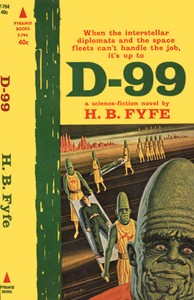
H. B. Fyfe's 1962 novel follows Department 99 agents as they manage a crisis involving a stolen file and a power blackout, with a narrative that shifts between tense action and bureaucratic deliberation.
Editorial Edition Score
4.7/5
★★★★★
★★★★★
Calculated from edition completeness, EPUB availability, text structure and catalogue metadata. Not a user rating.
How this score is calculated
- Description quality20 pts
- Title & short description10 pts
- Source metadata20 pts
- Text length15 pts
- Chapters / structure15 pts
- EPUB file integrity20 pts
Total of 100 points, scaled to a 2.5-5.0 range. Editions with an empty description or a missing EPUB file are not scored.
Edition quality
Public-domain source text
Read the source text
The source text is kept in the dedicated reader, separate from this catalogue record and its commentary.
The novel opens with a breathless chase: rockets slam past a gaunt man fleeing the Earth Embassy, a blaster shot missed, stolen papers in hand. Yet the very next chapter settles into the mundane routine of Department 99, where Westervelt returns from a London trip and secretaries chat about coat fashions. This abrupt shift from pulp-action to office small talk establishes a central tension: the story oscillates between high-stakes espionage and the procedural hum of a government agency.
Fyfe's prose mirrors this duality. Action sequences are clipped and immediate—'He'd killed one man, wounded others'—while office scenes linger on filtered light, desk arrangements, and the 'lazy smile' of a secretary. The narrative voice remains detached, reporting events without interiority, which amplifies the contrast between the chaos of the opening and the controlled calm of the department.
Voice and the Bureaucratic Lens
The narration in D-99 is notably external, focusing on observable behavior rather than internal thought. Characters are described through physical actions: Westervelt 'flushed, to his disgust'; Smith 'lumbered' with a 'scowl of concentration'; Parrish 'threw up his hands' and 'walked loosely.' This technique keeps the reader at a distance, aligning with the story's focus on surveillance and hidden motives.
Dialogue carries the burden of exposition, often through terse exchanges that reveal hierarchy and tension. When Smith explains Lydman's past imprisonment, he pauses deliberately, 'as if to let Beryl recall other remarks.' The characters themselves are often uncertain, guessing at motives—'Maybe we could dope him,' suggests Parrish 'without much feeling.' The narrative never confirms whether these guesses are correct, leaving ambiguity that mirrors the agents' own limited knowledge.
Pacing and the Interruption of Crisis
The novel's rhythm is defined by interruptions. The opening chase is cut short by the chapter break; the office routine is punctured by Smith's sudden entrance; the discussion of Lydman's condition is interrupted by a phone call about Harris. These structural breaks create a sense of constant deferral—the promised action is always just out of reach, replaced by planning and debate.
Fyfe uses this to build tension. The power blackout, for instance, is introduced as a background problem, then discussed at length: 'How long can it take, after all?' Smith asks. Westervelt's silent speculation—'What if they think they have it fixed, turn on the juice again, and it blows a second time?'—adds a layer of unease. The pacing thus mirrors the agents' own frustration, as they are 'powerless to do anything' while waiting for events to unfold.
Setting as a Character: The Office and the Blackout
The Department 99 office is rendered with precise, almost architectural detail: the ninety-fifth floor, the private elevator, the 'double, transparent doors' with the discreet legend. The windows 'filtered the late afternoon light to a mellow tint,' and later, Westervelt adjusts a 'filter dial for maximum clarity.' This attention to the physical space grounds the speculative elements in a recognizable, corporate environment.
The blackout transforms this setting. From the window, Westervelt sees 'a great black carpet across part of the city,' with only 'sparse and faint glows of emergency lights.' The contrast between the controlled interior and the chaotic exterior underscores the department's limited power. The setting itself becomes a source of tension: the office, once a sanctuary of procedure, becomes a trap where characters must 'keep calm' and 'keep Bob busy' until power is restored.
Readers should attend to how Fyfe uses the office setting to frame the speculative elements. The blackout, the stolen papers, and the mysterious Harris transmission are all filtered through the mundane routines of Department 99, creating a distinctive tone that is neither pure action nor pure satire. The novel rewards attention to small details—a glance, a pause, a character's habitual gesture—that accumulate into a portrait of an agency struggling to maintain control.
Some nights I think of that grey, procedural tension in D-99, the way control slips sideways during a blackout. It reminds me, oddly, of how The Metal Monster — Themes and Context handles menace without spectacle—both feel like watching a quiet room slowly fill with something unnameable. There’s comfort in that patience, I suppose.
There are no reviews for this eBook.
There are no comments for this eBook.
Reader reflection
What was your reading experience?
Capture what you thought, learned, and would like to remember.
Your progress
0
/
10
2
Was reading this book enjoyable?
3
Would you recommend this book to another reader?
4
How demanding did the text feel?
5
What was the strongest part of the book?
6
Would you start a conversation about this book?
7
How clear did the writing feel?
8
Would you read this book again?
9
Which lesson or insight stayed with you?
10