1

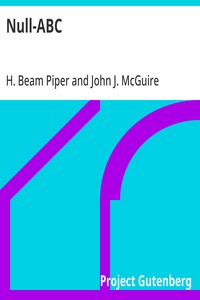
Null-ABC — Reading Companion
(0 User reviews)
2205
Project Gutenberg
2006
Not confirmed
Science fiction; Literacy -- Fiction; Nuclear warfare -- Social aspects -- Fiction
Readers of public-domain and historical texts
Project Gutenberg digital edition
en
Edition facts
Words
38,457
Reading time
168 min
Text sections
4
Null-ABC — Reading Companion can be approached with a clearer sense of reading commitment from its source measurements: 38,457 words, 2 hr 48 min estimated reading time, and 4 detected text sections.
The text analysis averages about 15.5 words per sentence, while the detected sections provide another way to judge how the source is divided.
Project Gutenberg metadata also associates the work with “Science fiction,” connecting these edition facts with the source record’s subject description.
Source:
Project Gutenberg record #18346
In a post-nuclear-war society where Literacy is a guarded professional monopoly, the Pelton family's discovery of their children's secret reading ability triggers a political crisis. The story moves between domestic scenes and Fraternity debates, using food, class, and the tension between Illiterates and Literates to explore the social control of knowledge.
Editorial Edition Score
4.6/5
★★★★★
★★★★★
Calculated from edition completeness, EPUB availability, text structure and catalogue metadata. Not a user rating.
How this score is calculated
- Description quality20 pts
- Title & short description10 pts
- Source metadata20 pts
- Text length15 pts
- Chapters / structure15 pts
- EPUB file integrity20 pts
Total of 100 points, scaled to a 2.5-5.0 range. Editions with an empty description or a missing EPUB file are not scored.
Edition quality
Public-domain source text
Read the source text
The source text is kept in the dedicated reader, separate from this catalogue record and its commentary.
The novel opens not with a political manifesto but with a breakfast table: Chester Pelton, a Senator and proud Illiterate, savors real eggs, bacon, and honey while his son Ray boasts of distinguishing natural from synthetic food. This domestic scene, rich with sensory detail—mouth-watering aromas, a photocell pantry door, the clink of platter covers—establishes a world where food authenticity signals class and ideology. The Pelton household is a bastion of Illiterate values, yet the children, Claire and Ray, have secretly learned to read. The tension between the cozy, familiar setting and the explosive secret it contains drives the narrative forward, as the private act of Literacy soon becomes a public, political affair.
The Politics of a Breakfast Table
The opening chapter uses the Pelton family meal to introduce the story's central conflict through small, telling details. Chester Pelton's pride in his son's ability to identify real versus synthetic food—"This is real bee-comb honey, too!"—immediately establishes a hierarchy of authenticity that mirrors the social divide between Illiterates and Literates. The breakfast itself, costing "a dollar under five C," is a luxury, and Claire's reproach of Ray for always thinking of cost reveals a generational tension. The mention of a neighbor's "'copter-bike" and Chester's dismissal of the boy as "a Literate!" shows how Literacy is a slur, a mark of inferiority. The scene is structured around a series of contrasts: natural vs. synthetic, thrift vs. indulgence, and, most crucially, Illiteracy vs. Literacy. The pantry door slides noiselessly, but the political fault lines are anything but quiet.
The Fraternity Chamber as Stage
The narrative shifts abruptly from the Pelton home to a meeting of the Associated Fraternities of Literates, where the debate over Claire and Ray's admission becomes a theatrical display of political maneuvering. The language here is formal and procedural—"Will Literate Graves yield for a motion?"—but the underlying emotions are raw. Harvey Graves denounces Claire's Literacy as "Black Literacy," while Wilton Joyner counters that the Fraternities should "respect Literate ability, wherever we find it." The scene is structured around a series of speeches and motions, with characters rising and yielding, seconding and amending. The dialogue is dense with legalistic terms, but the real drama lies in the power struggle between factions. Lancedale's surprise seconding of Joyner's motion, followed by his amendment to administer the Literates' oath, reveals a trap being sprung. The chamber becomes a stage for a political chess game, where the fate of two young people is secondary to the struggle for control of the Fraternities.
Recurring Images of Authenticity and Control
Throughout the excerpts, the story returns to images of authenticity and its opposite. The breakfast scene's real eggs, bacon, and honey are echoed in the Fraternity debate's concern with "genuine" Literacy versus "Black Literacy." The word "real" appears repeatedly: real food, real cow-made butter, real bee-comb honey. This obsession with the genuine extends to Literacy itself, which is treated as a commodity that can be authentic or counterfeit. The Fraternities' control over Literacy is portrayed as a monopoly, with fees and percentages, and Claire's unauthorized learning is a threat to that system. The setting itself moves between the private, authentic space of the home and the public, controlled space of the Fraternity chamber. This movement mirrors the central tension: the individual's right to knowledge versus society's attempt to regulate it. The recurring image of food—natural, expensive, and exclusive—serves as a metaphor for Literacy itself: a rare and valuable resource that only the privileged can access.
Movement Between Private and Public Spheres
The story's structure is built on a series of sharp transitions between intimate domestic scenes and formal public debates. The breakfast table, with its family dynamics and personal loyalties, gives way to the Fraternity meeting, where abstract principles and political alliances take center stage. This movement is not merely a change of setting but a shift in register: from the colloquial, sensory language of the home to the legalistic, procedural language of the chamber. The characters themselves are transformed: Claire, who at home is a caring sister and daughter, becomes in the debate a symbol—"a Literate to a degree that would be a credit to any Literate First Class." The private act of reading, done in secret, becomes a public issue debated by strangers. The narrative's back-and-forth between these spheres highlights the collision between personal identity and social role, and suggests that in this world, no act is truly private. The movement itself is a structural device that keeps the reader off-balance, mirroring the characters' own uncertainty about where the boundaries lie.
Readers should pay attention to the way the story uses physical objects—food, clothing, household technology—to signal social status and political allegiance. The narrative rarely tells you directly what to think; instead, it shows you what characters eat, how they speak, and where they stand in a room. The excerpts give only a partial view of the plot, but they reveal a world built on carefully observed details and a structure that moves between the intimate and the institutional. The tension between these two poles is the engine of the story.
There’s a moment in Null-ABC where the Peltons’ quiet domestic world shifts under the weight of a single secret, and I found myself thinking about the very private act of slipping words into a place they weren’t supposed to fit. That same hush lingers in Fugue — Reading Notes, like an old friend’s sigh between chapters.
There are no reviews for this eBook.
There are no comments for this eBook.
Reader reflection
How will you remember this book?
Save your reaction, strongest insight, and memorable passage.
Your progress
0
/
10
2
How did the book work for you overall?
3
Would you recommend this book to another reader?
4
What was the reading difficulty like?
5
Do you expect to return to this book?
6
How distinctive were its ideas or approach?
7
Would this book work well in a reading group?
8
Did any part of the book stay with you emotionally?
9
What changed or sharpened your thinking?
10