1

The crystal ray — Key Ideas to Explore
(0 User reviews)
1701
Project Gutenberg
2024
Not confirmed
Science fiction; Short stories; War stories; Weapons -- Fiction
Readers of public-domain and historical texts
Project Gutenberg digital edition
en
Edition facts
Words
9,233
Reading time
41 min
Text sections
1
Before opening The crystal ray — Key Ideas to Explore, the edition data offers a quick orientation: 9,233 words, 41 min estimated reading time, and 1 detected text section.
The text analysis averages about 19.9 words per sentence, while the detected sections provide another way to judge how the source is divided.
Project Gutenberg metadata also associates the work with “Science fiction,” connecting these edition facts with the source record’s subject description.
Source:
Project Gutenberg record #73926
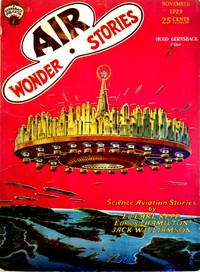
In 2141 A.D., during a war between Caucasian nations and Asia, U.S. scout Joseph Pelton develops a crystal ray weapon. The story follows his race to deploy it as enemy forces close in on Chicago, blending technical detail with aerial combat.
Editorial Edition Score
4.4/5
★★★★★
★★★★★
Calculated from edition completeness, EPUB availability, text structure and catalogue metadata. Not a user rating.
How this score is calculated
- Description quality20 pts
- Title & short description10 pts
- Source metadata20 pts
- Text length15 pts
- Chapters / structure15 pts
- EPUB file integrity20 pts
Total of 100 points, scaled to a 2.5-5.0 range. Editions with an empty description or a missing EPUB file are not scored.
Edition quality
Public-domain source text
Read the source text
The source text is kept in the dedicated reader, separate from this catalogue record and its commentary.
The story opens in the war year 2141 A.D., with a small U.S. battle flier speeding south at fifteen miles altitude. The craft relies on a Whitley gravitational screen and hissing gas jets, while its two occupants—ace George Calhoun and scientist Joseph Pelton—wear oxygen masks and metal armor. The narrative quickly establishes a world where the United States is the last formidable Occidental power resisting Asian air fleets. Pelton, a peace-time scientist turned fighter, is central to the plot: his invention, a crystal ray, promises to turn the tide. The excerpt shows him directing crews to prepare a large cylinder, then activating a device that emits bluish beams, disabling enemy ships. The description of the battle—a vast oval patch of white light with insect-like specks—underscores the scale of conflict.
Technical Specificity and the Ray's Mechanism
The story grounds its speculative weapon in detailed engineering. Pelton’s ray is not a vague death beam; it passes through metal “as though it had been made of glass,” leaving ships intact but their occupants incapacitated. The preparation sequence is meticulous: crews lubricate valves with “L. F. liquid,” examine “Z wires,” fill tanks with “liquid terrorium preparation,” and bolt a cylinder head into place. The activation involves dials and a “big black switch,” producing “ponderous throbs” and flashes like lightning. This technical texture suggests Gallun’s interest in plausible science, even as the ray’s exact nature remains unexplained in the excerpt.
Contrasts Between the Scientist and the Ace
The two protagonists embody different wartime roles. George Calhoun is the ace with over sixty victories, including bombing battleships of the skies. Joseph Pelton, by contrast, is “not so successful a fighter” but devoted to science. Their dynamic is sketched lightly: Calhoun holds the controls while Pelton frets over calculations. When the ray succeeds, Pelton feels “mighty exultation” and a “grim smile” passes over his lips—he knows what happened to the enemy. This pairing of action hero and inventor is a familiar pulp trope, but the story gives Pelton the decisive moment, privileging scientific ingenuity over combat prowess.
The Siege of Chicago and Atmospheric Description
The battle is depicted as a looming natural phenomenon: a “vast oval patch of white light, looking like the head of some enormous comet,” drifting ominously near. The enemy fleet drops “plummet-like from the sky,” and bombs fall like “big raindrops that herald a summer thundershower.” The green chemical gas that “ate into human flesh like sulphuric acid” adds a visceral horror. Chicago’s citizens watch with “mingled doubt, fear, and hope.” This blend of cosmic imagery and chemical warfare creates a tense atmosphere, emphasizing the fragility of the city beneath an overwhelming aerial assault.
Readers should note that the excerpt ends before the ray’s full deployment and its aftermath. The story’s brevity (about 9,200 words) suggests a focused narrative, likely centering on Pelton’s invention and a single decisive engagement. Pay attention to how Gallun balances technical exposition with action, and whether the ray’s moral implications—it disables without destroying—are explored further.
Finishing The Crystal Ray left me with that odd ache—how Joseph’s quiet race against devastation sticks around long after the last page. It reminded me of another story that lingered the same way, something about the weight of a single decision. Remember the 4th! — Inside the Classic keeps that feeling close, soft and unresolved. I still think about it some evenings.
There are no reviews for this eBook.
There are no comments for this eBook.
Reader reflection
Take a moment to reflect on this book
Create a short personal record of your experience with this book.
Your progress
0
/
10
2
Did this book hold your interest?
3
How likely are you to recommend this book?
4
How easy was the book to follow?
5
Could you see yourself revisiting this book?
6
How closely did the book connect with your experience?
7
Which part made the strongest impression?
8
How well did it match your expectations?
9
What changed or sharpened your thinking?
10