1

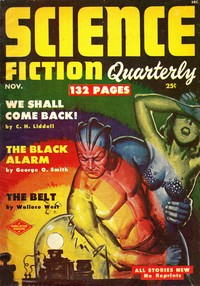
The belt — Story, Setting & Ideas
(0 User reviews)
73
Project Gutenberg
2023
Not confirmed
Science fiction; Short stories; Islands -- Fiction; Factories -- Fiction; Mines and mineral resources -- Fiction; Human evolution -- Fiction
Readers of public-domain and historical texts
Project Gutenberg digital edition
en
Edition facts
Words
8,874
Reading time
39 min
Text sections
1
The source record for The belt — Story, Setting & Ideas measures this digital text at 8,874 words, 39 min estimated reading time, and 1 detected text section.
The text analysis averages about 13.4 words per sentence, while the detected sections provide another way to judge how the source is divided.
Project Gutenberg metadata also associates the work with “Science fiction,” connecting these edition facts with the source record’s subject description.
Source:
Project Gutenberg record #70647
Wallace West's 1951 story follows Jonathan Robertson's return to a Caribbean island where a factory workforce has devolved into near-mute laborers. The opening establishes a mystery around the silent workers, while later excerpts reveal a tragic romance and a desperate standoff, all framed by a speculative take on Lamarckian evolution.
Editorial Edition Score
4.4/5
★★★★★
★★★★★
Calculated from edition completeness, EPUB availability, text structure and catalogue metadata. Not a user rating.
How this score is calculated
- Description quality20 pts
- Title & short description10 pts
- Source metadata20 pts
- Text length15 pts
- Chapters / structure15 pts
- EPUB file integrity20 pts
Total of 100 points, scaled to a 2.5-5.0 range. Editions with an empty description or a missing EPUB file are not scored.
Edition quality
Public-domain source text
Read the source text
The source text is kept in the dedicated reader, separate from this catalogue record and its commentary.
The story opens with a captain refusing to dock at New Patmos, calling it “rum” because the dock workers are silent and unsmiling. Jonathan Robertson, returning after twenty years, learns his father has died and that the island’s laborers—once English workmen—now communicate only with grunts like “Yah!” This eerie transformation is the first hint of the social experiment begun by his ancestor in the 18th century.
West quickly establishes a tone of unease through the captain’s superstition and the workers’ mechanical responses. The island’s name, New Patmos, evokes exile and revelation, hinting at the strange evolution to come. The reader is drawn into a mystery that blends science fiction with colonial gothic.
Silent Workers and a Stifled Island
The early pages focus on the contrast between Jonathan’s memories and the present reality. The workers, led by Old Tom, are described as “ebony-colored” and speak in clipped West Indian accents, but the younger men—Bill, Fred, Dick—only grunt. Their uniformity is unsettling: each responds with the same “Yah!” when given an order. The captain’s crew refuses to go ashore, believing the workers are “jumbies” (ghosts). This detail, along with the island’s name, suggests a place cut off from normal life.
Jonathan’s father, the sixth Jonathan Robertson, is dead, and the factory and mine still operate, but the human cost is visible in the workers’ blank faces. West uses the setting—a Caribbean island with a British colonial past—to create a closed environment where a strange social experiment has run unchecked for generations.
A Forbidden Romance and a Fatal Misstep
Midway through the excerpts, Jonathan becomes infatuated with a female worker named Jo. She is curious but fearful, bound by a “law” she cannot fully articulate. When Jonathan invites her into his house, she hesitates, saying “Law say…,” but he dismisses it. He locks her in an upstairs room, hoping to “jolt her out of her rut.” Instead, she panics, climbs out the window, and falls to her death.
This scene is the emotional pivot. Jonathan’s arrogance—treating Jo as a subject for reeducation rather than a person—leads directly to tragedy. Old Tom’s warning, “You can’t do anything. They live in darkness,” underscores the workers’ altered state. The romance is brief but devastating, and it forces Jonathan to confront the consequences of his family’s project.
A Pact Forged Over a Body
After Jo’s death, Jonathan and Old Tom bury her and then barricade themselves in the factory. The language shifts to a grim determination: “Together it is, then.” They repair doors and windows, working through the night, aware of unseen watchers. This sequence builds tension as the two men prepare for a siege against the very workers Jonathan once dismissed as harmless.
The bond between Jonathan and Tom is the story’s emotional core. Tom, who had served the family for decades, finally breaks down, sobbing in fear. Jonathan, though heartbroken, finds warmth in Tom’s “humanness.” Their alliance is a fragile hope against the island’s creeping dehumanization. West leaves the outcome uncertain, but the image of the two men alone in the factory, surrounded by silent workers, is a powerful close to the excerpts.
Lamarckian Hints and the Unseen Experiment
The story opens with an epigraph about Lamarck’s theory of inheritance of acquired characteristics, calling it “bad” science but suggesting that if certain experiments could be made… This frames the entire narrative as a speculative test case. The workers’ silence and limited vocabulary may be the result of generations of conditioning—an environment that selected for obedience and simplicity.
West does not explain the mechanism, but the clues are there: the workers’ identical responses, their fear of the house, their inability to name common objects (Jo cannot recall “mimosa”). The island itself is a laboratory, and the Robertson family are the experimenters. Jonathan’s return and his disastrous attempt to “help” Jo only accelerate the crisis. The reader is left to wonder whether the experiment can be reversed—or if it has already gone too far.
These excerpts offer a self-contained arc: a mystery, a romance, a death, and a standoff. The full story likely resolves the siege and the fate of the workers, but the reader can already see the moral weight of the Robertsons’ project. Pay attention to the epigraph—it is not just decoration but a key to the story’s logic. West uses science fiction to explore class, colonialism, and the limits of social engineering, all within a tight, atmospheric narrative.
Reading The Belt, I kept thinking about those silent workers and how their stillness lingered in me long after. It reminded me of something softer I once jotted down, a note about Excitement for sale — Reading Notes, where a similar hush felt less tragic and more like waiting. Both left me quiet, in different ways, as if stories sometimes speak through what they withhold rather than what they say.
There are no reviews for this eBook.
There are no comments for this eBook.
Reader reflection
How will you remember this book?
Save your reaction, strongest insight, and memorable passage.
Your progress
0
/
10
2
How much did you enjoy the reading experience?
3
Would you encourage someone else to read it?
4
How demanding did the text feel?
5
Was the book what you thought it would be?
6
Is this a title worth rereading?
7
Which element worked best for you?
8
Did any part of the book feel personally relevant?
9
What is the main idea you are taking away?
10