1

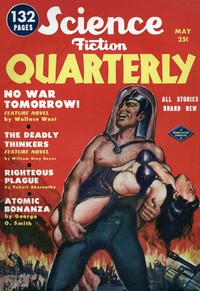
Atomic bonanza — Key Ideas to Explore
(0 User reviews)
1069
Project Gutenberg
2023
Not confirmed
Science fiction; Short stories; Businessmen -- Fiction; Inventions -- Fiction; Physicists -- Fiction; Radioactivity -- Fiction
Readers of public-domain and historical texts
Project Gutenberg digital edition
en
Edition facts
Words
8,590
Reading time
38 min
Text sections
1
For Atomic bonanza — Key Ideas to Explore, the stored edition analysis reports 8,590 words, 38 min estimated reading time, and 1 detected text section.
The text analysis averages about 14.7 words per sentence, while the detected sections provide another way to judge how the source is divided.
Project Gutenberg metadata also associates the work with “Science fiction,” connecting these edition facts with the source record’s subject description.
Source:
Project Gutenberg record #70475
In a 1951 science fiction short story, a physicist demonstrates a device that neutralizes radioactivity, but corporate rivalry between a research director and a business manager threatens the invention's fate. The narrative focuses on office politics and scientific skepticism.
Editorial Edition Score
4.4/5
★★★★★
★★★★★
Calculated from edition completeness, EPUB availability, text structure and catalogue metadata. Not a user rating.
How this score is calculated
- Description quality20 pts
- Title & short description10 pts
- Source metadata20 pts
- Text length15 pts
- Chapters / structure15 pts
- EPUB file integrity20 pts
Total of 100 points, scaled to a 2.5-5.0 range. Editions with an empty description or a missing EPUB file are not scored.
Edition quality
Public-domain source text
Read the source text
The source text is kept in the dedicated reader, separate from this catalogue record and its commentary.
The story opens not in a laboratory but at a reception desk where a visitor's credentials are inspected by a receptionist described as a "rare combination of brains and beauty." This sets the tone for a tale that balances scientific wonder with office politics. The headquarters of General Atomic Research is divided into two opposing camps: the office of Howard Mangler, Director of Research, and that of Phillip Newton, Director of Operations. The corridor between them is called "The Battlefield" by the staff, where battles are fought with memorandums and directives. The narrative quickly establishes that the real conflict is not about science but about control—Mangler resents a "mere business man" running operations, while Newton thinks physicists should stay in their "white ivory tower."
The Battlefield of Bureaucracy
The story's opening pages devote considerable space to the ongoing feud between Mangler and Newton, described in martial terms: "the silent battle raged, its casualties mutely entombed in the filing cabinets." The staff prepares for outbreaks of conflict with phrases like "Grant has just invaded Richmond," using Civil War analogies to signal impending confrontations. This bureaucratic warfare is not a backdrop but a central mechanism that drives the plot. When Velikof arrives with his revolutionary device, the two directors immediately view it through the lens of their rivalry. Mangler wants to test it himself; Newton insists on a second check-out. Their struggle for control over the invention mirrors their struggle for control over the company. The story suggests that scientific progress can be hindered as much by internal politics as by technical challenges.
The Impossibility Made Real
Doctor Velikof demonstrates a machine that decontaminates radioactive material, converting dangerous radiation into "harmless radiations of mere light, a bit of electrostatic discharge, and a burst of magnetic field." The process is described as "heterodyning" the energetic radiation into harmless energy. The demonstration is convincing: a sample that initially makes Geiger counters chatter is rendered completely inert. Yet the story undercuts the triumph with hints of sloppiness. Newton fumbles with measurements, and Mangler accuses him of being "as sloppy as a kid." Velikof grows increasingly nervous, mentioning that the banks close at noon and that he must leave because "there are men who would kill me for what I've done." The device works, but the circumstances surrounding its demonstration are fraught with tension and haste, leaving the reader to wonder whether the process is as reliable as it appears.
The Unreliable Inventor
Velikof is an enigmatic figure. He arrives with a world-changing invention but behaves like a man on the run. He checks his watch repeatedly, mentions the bank closing time, and finally refuses payment, handing back the envelope and saying, "I'm not selling." His motives remain unclear from the excerpts. Is he a genius fleeing from those who would exploit his work, or a charlatan who knows his device is flawed? The story leaves this ambiguous. When Newton performs a second, sloppy test that also succeeds, Velikof seems surprised: "Dead?" he repeats. His reaction suggests he may not fully trust his own invention. The excerpts do not reveal whether the device is genuine or a fluke, but they establish that the characters' perceptions of its validity are shaped more by their own biases than by objective evidence.
Readers should pay close attention to the details of the demonstration and the characters' reactions. The story's title, "Atomic Bonanza," suggests a windfall, but the excerpts hint at potential disaster. The interplay between scientific possibility and human fallibility is the story's core. The incomplete excerpts leave the outcome uncertain, making the tale a puzzle that rewards careful reading of the clues provided.
In that old atomic tale, what stayed with me wasn't the gadget, but the quiet dread over a good idea falling into grasping hands. There is a certain comfort, then, in how Parking, unlimited — Reading Companion stewards a different kind of invention—one meant for easing daily life, not powering it. They sit well together on a shelf, whispering of promise and caution. Parking, unlimited — Reading Companion feels like the calmer cousin to that anxious office, and I’ve often found myself lingering between them.
There are no reviews for this eBook.
There are no comments for this eBook.
Reader reflection
How did this book work for you?
Your answers remain private and are stored only in this browser.
Your progress
0
/
10
2
Was reading this book enjoyable?
3
Would you recommend this book to another reader?
4
How easy was the book to follow?
5
Could you follow the author’s main argument?
6
Would a second reading be valuable?
7
Did it raise ideas you would like to talk about?
8
What was its emotional impact?
9
What did this book teach you most?
10