1


Respectfully mine — Background and Themes
(0 User reviews)
1452
Project Gutenberg
2023
Not confirmed
Science fiction; Short stories; Criminals -- Fiction; Time capsules -- Fiction
Readers of public-domain and historical texts
Project Gutenberg digital edition
en
Edition facts
Words
11,494
Reading time
50 min
Text sections
2
For Respectfully mine — Background and Themes, the stored edition analysis reports 11,494 words, 50 min estimated reading time, and 2 detected text sections.
The text analysis averages about 15.6 words per sentence, while the detected sections provide another way to judge how the source is divided.
Project Gutenberg metadata also associates the work with “Science fiction,” connecting these edition facts with the source record’s subject description.
Source:
Project Gutenberg record #72147
Randall Garrett's 1958 story uses a mock-scholarly frame to recount the exploits of Leland Hale, a brilliant, ruthless interstellar thief. The opening excerpts establish a retrospective tone, a cat-and-mouse chase, and a time-capsule heist plot, with the narrator's psychometric analysis and folk-hero commentary shaping how readers interpret Hale's actions.
Editorial Edition Score
4.5/5
★★★★★
★★★★★
Calculated from edition completeness, EPUB availability, text structure and catalogue metadata. Not a user rating.
How this score is calculated
- Description quality20 pts
- Title & short description10 pts
- Source metadata20 pts
- Text length15 pts
- Chapters / structure15 pts
- EPUB file integrity20 pts
Total of 100 points, scaled to a 2.5-5.0 range. Editions with an empty description or a missing EPUB file are not scored.
Edition quality
Public-domain source text
Read the source text
The source text is kept in the dedicated reader, separate from this catalogue record and its commentary.
The story opens not with a scene but with a scholarly voice: a narrator who claims to reconstruct the life of Leland Hale through “modern psychometric analysis” and fragmentary records. This framing immediately distances the reader from direct action, inviting us to view Hale as a figure of legend—compared to Robin Hood and Jesse James, but worse. The narrator’s dry, analytical tone contrasts with the colorful criminal it describes, setting up a tension between cold fact and romantic myth.
From the first paragraph, the text signals that this is not a straightforward chase. The difficulty of tracking a “wily, clever, and thoroughly ruthless scoundrel” across “a million parsecs of space and a half century of time” is emphasized. The reader is warned that the account will be deduced rather than chronicled, making every subsequent scene a piece of a puzzle assembled by an unseen historian.
The Narrator’s Unreliable Frame
The opening pages establish a narrator who claims objectivity but revels in hyperbole. Leland Hale is called “the cleverest crook in the universe” and “worse than all the rest rolled together.” Yet the narrator admits the records are “too sketchy” for a coherent chronology. This contradiction—certainty about Hale’s character paired with uncertainty about his deeds—creates a playful unreliability. Readers should note how the narrator’s confident assertions (e.g., “modern psychometric analysis enables us to pinpoint his character down to the seventieth decimal place”) are undercut by the very gaps they claim to fill. The epigraph from Chesterton—“Thieves respect property”—further hints that the story may be as much about perception as about theft.
Hale’s Introduction: Size and Swagger
When Leland Hale finally appears in person, the description is precise: “six feet six in his bare feet,” 138 kilograms, black hair, tanned skin, a “hard, blocky, and handsome” face. The narrator insists the legends do not exaggerate his physical size. This attention to bodily presence grounds the mythic figure in tangible detail. In the dialogue with Hinrik Fonshliezen, Hale’s menace is conveyed through small gestures—pointing a finger a “scant eighth of an inch” from the other’s nose, speaking in “chilled steel.” His casual threat (“I’m allergic to prisons… They give me a pain—here,” patting his hip pocket) blends humor with danger. These early interactions establish Hale as a man who controls every conversation through physical and psychological dominance.
The Time Capsule as MacGuffin
The plot centers on a “Dachboden” statue destined for a time capsule on the planet Apfahl. Captain Whitter, a police officer, believes Hale will attempt the theft because of his pride: “He hits and runs and then comes back to hit again… he’s smart and he’s got guts. And he’s got pride.” The time capsule is described as “closely-guarded,” and the news services are watching. Yet the narrator undercuts Whitter’s certainty with a wry aside: “The captain was right, as far as he went. Pity he didn’t know Leland Hale a little better.” This narrative intrusion signals that the reader knows more than the characters—or at least that the story will reward attention to what the narrator chooses to reveal.
Voice and Structure: A Detective Story in Reverse
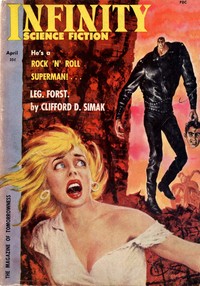
The story’s structure is unusual: it begins with the outcome (Hale is legendary, his crimes known) and works backward to explain how he achieved them. The narrator’s voice is that of a future historian, using phrases like “a century ago” and “folk legend.” This retrospective stance means that suspense comes not from whether Hale will succeed, but from how he will outwit his pursuers. Readers should watch for the narrator’s interjections—such as the comment about Whitter’s incomplete knowledge—as clues to the story’s ironic tone. The text also includes a Transcriber’s Note placing it in Infinity magazine (August 1958), grounding the science fiction in its pulp-era context.
Because the narrator presents a deduced rather than chronological account, pay attention to what is left unsaid. The gaps in the record are as important as the documented moments. Hale’s character is described in absolutes, but the story’s pleasure lies in watching those absolutes tested by circumstance. Treat each scene as a piece of evidence in a case the narrator is building—and remember that the narrator may have his own biases.
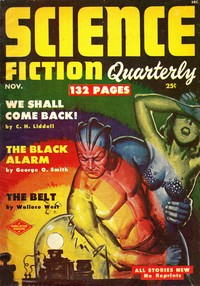
Re-reading Hale’s careful audacity, I remembered sitting on a cold porch with The belt — Story, Setting & Ideas, feeling that same odd tenderness for a character who steals not out of greed, but out of a private logic. Both books let me watch someone move through a world that mislabels them. It’s a quiet comfort, recognizing a kindred kind of loneliness in fiction. The belt — Story, Setting & Ideas lingers with me that way.
There are no reviews for this eBook.
There are no comments for this eBook.
Reader reflection
Before you leave, reflect on the book
Use these questions to collect your thoughts before moving on.
Your progress
0
/
10
2
What was your overall reaction to the book?
3
Would you encourage someone else to read it?
4
What was the reading difficulty like?
5
Did you gain anything practical from the text?
6
Did you relate to its people, ideas, or situations?
7
Did the book offer a fresh perspective?
8
Would you read this book again?
9
What changed or sharpened your thinking?
10