1


Try to remember! — Edition Insights
(0 User reviews)
2502
Project Gutenberg
2024
Not confirmed
Science fiction; Human-alien encounters -- Fiction; Communication -- Fiction; Psychologists -- Fiction; Earth (Planet) -- Fiction
Readers of public-domain and historical texts
Project Gutenberg digital edition
en
Edition facts
Words
16,969
Reading time
74 min
Text sections
3
The source record for Try to remember! — Edition Insights measures this digital text at 16,969 words, 1 hr 14 min estimated reading time, and 3 detected text sections.
The text analysis averages about 10.9 words per sentence, while the detected sections provide another way to judge how the source is divided.
Project Gutenberg metadata also associates the work with “Science fiction,” connecting these edition facts with the source record’s subject description.
Source:
Project Gutenberg record #73595
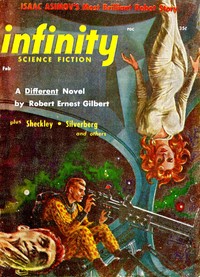
Frank Herbert's 1961 novella uses a linguist protagonist and an alien ultimatum to explore how language shapes perception. The narrative shifts from global panic to intimate interrogation, with Virgil Finlay's illustrations complementing the tension between spoken words and unspoken meaning.
Editorial Edition Score
4.5/5
★★★★★
★★★★★
Calculated from edition completeness, EPUB availability, text structure and catalogue metadata. Not a user rating.
How this score is calculated
- Description quality20 pts
- Title & short description10 pts
- Source metadata20 pts
- Text length15 pts
- Chapters / structure15 pts
- EPUB file integrity20 pts
Total of 100 points, scaled to a 2.5-5.0 range. Editions with an empty description or a missing EPUB file are not scored.
Edition quality
Public-domain source text
Read the source text
The source text is kept in the dedicated reader, separate from this catalogue record and its commentary.
The story opens with a striking image: a spaceship 'flapped out of a gun-metal sky over Oregon, its shape that of a hideously magnified paramecium.' This visceral description sets the tone for a narrative that oscillates between global-scale crisis and intimate psychological drama. Frank Herbert quickly establishes a world where the alien ultimatum—'Talk or Die!'—has triggered mass hysteria, bestseller lists dominated by science fiction, and a suicide epidemic. Yet the prose remains controlled, even clinical, as it details the environmental grit of Eastern Oregon alkali flats. The contrast between the cosmic threat and the mundane particulars of wind, sand, and quail creates a grounding effect that will persist throughout the work.
A Linguist's Perspective on Alien Contact
Herbert centers the narrative on Dr. Francine Millar, a psychologist specializing in language. Rather than a military or diplomatic response, the story foregrounds her expertise in semantics and communication. The aliens' demand—'You must break away from this limited communication!'—frames the conflict as fundamentally linguistic. Francine's husband, also a language expert, died under suspicious circumstances before the aliens arrived, a detail that introduces a conspiracy thread. The text emphasizes that 'the people who might have solved this problem died before the problem was even presented,' suggesting a deliberate silencing of linguistic knowledge. Herbert uses Francine's professional background to question assumptions about language: 'Language clutches at us with unseen fingers,' she recalls her husband saying. This intellectual framework gives the story a distinctive voice, one that values the study of communication as much as the plot's action.
Shifting Pace: From Global Panic to Tense Interrogation
The narrative pace changes markedly between the opening scenes of worldwide chaos and the later, claustrophobic conversations inside military facilities. Early paragraphs move quickly, with short declarative sentences: 'The suicide rate was up and still climbing. Religious cults were having a field day.' The spaceship's arrival is described in a single, dense paragraph. But once Francine is brought into a room with officials Langsmith and Speidel, the tempo slows. Dialogue becomes the primary vehicle, with long exchanges punctuated by physical details—'Langsmith puffed a cloud of smoke before his face.' The interrogation scene builds tension through Francine's internal questions: 'Why are they telling me all this?' Herbert uses this shift to mirror the story's theme: the difficulty of communication under pressure. The reader, like Francine, must parse information from multiple, possibly unreliable sources.
Recurring Details and the Texture of Suspicion
Several small details recur to create a sense of unease. The aliens are consistently described as 'froglike,' a word that appears multiple times, reinforcing their otherness. The spaceship's shape—'hideously magnified paramecium'—is echoed later when it is called 'a monstrous oval of dun canvas draped across upright sticks.' The environment of the Oregon flats, with its 'dry particles of grit that crept under everything,' becomes a metaphor for the invasive, inescapable nature of the alien presence. Herbert also plants specific clues: the mention of 'twenty-eight mysterious deaths' before the aliens' arrival, the 'brilliant beam of light' that sliced a plane's wing, and the revelation of 'more than five hundred space craft' near the moon. These details accumulate, suggesting a larger conspiracy that Francine must navigate. The story's voice remains precise, even when describing paranoia, grounding the speculative elements in concrete observations.
Readers should pay close attention to how Herbert uses Francine's professional knowledge to challenge the assumptions of the military characters. The story rewards careful reading of its dialogue, where characters often talk past each other. The unfinished excerpt leaves key questions unanswered, but the linguistic framework—especially the idea that 'through language, we impose upon each other our ways of looking at things'—provides a lens for interpreting the aliens' true intentions. The interplay between what is said, what is withheld, and what is implied drives the narrative forward.
There’s a moment in Frank Herbert’s novella where the linguist realizes the alien ultimatum isn’t about words at all—it’s about the silence between them. Finlay’s illustrations caught that weight perfectly. I keep thinking how language shapes what we can even fear, which is why I revisit Corpus earthling’s strangeness now and then. Corpus earthling — Story, Setting & Ideas feels like an old friend who understands that quiet dread.
There are no reviews for this eBook.
There are no comments for this eBook.
Reader reflection
Record your reading impressions
A brief reflection can help important ideas stay with you longer.
Your progress
0
/
10
2
Was reading this book enjoyable?
3
Would you recommend this book to another reader?
4
What was the reading difficulty like?
5
What was the strongest part of the book?
6
Would you read this book again?
7
Did the book deliver what you hoped for?
8
Would you like to discuss this book with someone?
9
What is the main idea you are taking away?
10