1

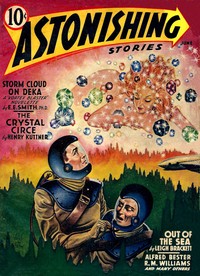
The Crystal Circe — Reading Companion
(0 User reviews)
705
Project Gutenberg
2022
Not confirmed
Science fiction; Male friendship -- Fiction; Storytelling -- Fiction; Human-alien encounters -- Fiction; Asteroids -- Fiction; Meteorites -- Fiction
Readers of public-domain and historical texts
Project Gutenberg digital edition
en
Edition facts
Words
12,071
Reading time
53 min
Text sections
2
The source record for The Crystal Circe — Reading Companion measures this digital text at 12,071 words, 53 min estimated reading time, and 2 detected text sections.
The text analysis averages about 11.2 words per sentence, while the detected sections provide another way to judge how the source is divided.
Project Gutenberg metadata also associates the work with “Science fiction,” connecting these edition facts with the source record’s subject description.
Source:
Project Gutenberg record #68726
Henry Kuttner's 1942 novella uses a framed narrative to recount Steve Arnsen's obsessive search for his vanished friend on a remote asteroid, where a mysterious crystal entity called Circe blurs the line between desire and destruction.
Editorial Edition Score
4.5/5
★★★★★
★★★★★
Calculated from edition completeness, EPUB availability, text structure and catalogue metadata. Not a user rating.
How this score is calculated
- Description quality20 pts
- Title & short description10 pts
- Source metadata20 pts
- Text length15 pts
- Chapters / structure15 pts
- EPUB file integrity20 pts
Total of 100 points, scaled to a 2.5-5.0 range. Editions with an empty description or a missing EPUB file are not scored.
Edition quality
Public-domain source text
Read the source text
The source text is kept in the dedicated reader, separate from this catalogue record and its commentary.
The story opens with a framing device set in a Manhattan Port Room, where the narrator Vail encounters a ravaged Steve Arnsen. The prologue establishes a strong contrast between Arnsen's former rakish vitality and his current haunted state, described through physical details: 'the searing mark of some experience lay there, branded into his furrowed cheeks, his tightened lips.' This initial scene sets up the central mystery—the disappearance of Douglas O'Brien—and introduces the asteroid setting through Arnsen's recollection.
Framing and Voice
The narrative is delivered through Vail's first-person perspective, who functions as a listener rather than a participant. This framing creates distance from the main events, allowing the reader to observe Arnsen's deterioration secondhand. Kuttner uses this structure to heighten the sense of unreliability: Arnsen's tale is filtered through Vail's recollection, and the reader never directly witnesses the asteroid events. The prose in the prologue is notably more ornate than the action sequences, with phrases like 'the mental communion of laughter and a dream' characterizing the friendship between Arnsen and O'Brien. This contrast between the polished framing and the raw, fragmented asteroid narrative underscores the psychological toll of the experience.
The Asteroid as a Hostile Stage
The asteroid setting is rendered through sensory deprivation and physical strain. Kuttner emphasizes the environment's hostility: 'the utter loneliness of space crushed down on him, with suffocating terror.' Arnsen's search for O'Brien becomes a grueling ordeal, described in terms of exhaustion and disorientation: 'Hour after hour he searched the tiny world, squinting against sun-glare, peering into black shadow.' The asteroid's scale is deliberately vague—it is 'tiny' yet large enough to lose a person. The crystals and the girl Circe appear as luminous phenomena, 'a rainbow glitter of coruscating light,' but their physical properties remain ambiguous. The narrative focuses on Arnsen's subjective experience rather than providing a coherent geography, reinforcing the sense of a nightmare landscape.
Circe and the Limits of Knowledge
The entity called Circe is introduced through Arnsen's desperate attempt to summon her using a crystal gem. She is described as 'lovely and alien,' with 'lashes still veiled the cryptic depth of her eyes.' The narrative deliberately withholds her nature: she is 'not human—no,' but her motivations and powers are never explained. Arnsen's reaction oscillates between hatred and obsession: 'He hated her, hated her relentless inhumanity, her incredible beauty.' The crystals themselves seem to respond to thought, as when Arnsen's 'thought probed out, forceful and summoning.' However, the story does not clarify whether Circe is a sentient being, a projection, or something else entirely. This ambiguity is central to the story's effect, leaving the reader as uncertain as Arnsen about what is real.
Readers should note that the excerpts cover only the prologue and early chapters, ending before the resolution of Arnsen's quest. The catalog subjects list 'male friendship' and 'storytelling' as themes, and the framing device indeed emphasizes the act of telling a story. However, the excerpts show that the friendship between Arnsen and O'Brien is more asserted than dramatized, and the narrative quickly shifts to Arnsen's solitary obsession. Pay attention to how the framing narrator Vail recedes after the prologue, and consider whether the story ultimately validates or undermines Arnsen's account.
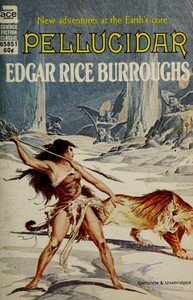
I finished The Crystal Circe and found myself thinking not of Kuttner's crystalline seduction, but of the hollow, patient stillness of the inner world. That same loneliness, the way a landscape can echo a mind’s yearning. It brought to mind an old guide I once flipped through, Pellucidar — A Reader’s Guide, and how both places feel like dreams you can almost touch.
There are no reviews for this eBook.
There are no comments for this eBook.
Reader reflection
Before you leave, reflect on the book
Use these questions to collect your thoughts before moving on.
Your progress
0
/
10
2
How much did you enjoy the reading experience?
3
Would you recommend this book to another reader?
4
How demanding did the text feel?
5
Would a second reading be valuable?
6
How useful did the reading feel?
7
Did anything about the book feel genuinely new?
8
Did you relate to its people, ideas, or situations?
9
What did this book teach you most?
10