1

Trajectory to Taurus — A Reader’s Guide
(0 User reviews)
703
Project Gutenberg
2023
Not confirmed
Science fiction; Short stories; Extraterrestrial beings -- Fiction; Human-alien encounters -- Fiction; Interstellar travel -- Fiction
Readers of public-domain and historical texts
Project Gutenberg digital edition
en
Edition facts
Words
9,614
Reading time
42 min
Text sections
1
This digital edition of Trajectory to Taurus — A Reader’s Guide is described by source-level measurements including 9,614 words, 42 min estimated reading time, and 1 detected text section.
The text analysis averages about 13.3 words per sentence, while the detected sections provide another way to judge how the source is divided.
Project Gutenberg metadata also associates the work with “Science fiction,” connecting these edition facts with the source record’s subject description.
Source:
Project Gutenberg record #72539
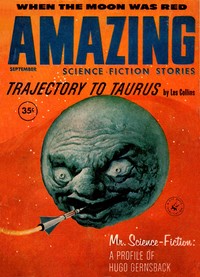
In Les Cole's 1960 science fiction story, astronaut Fred Kirr sees a planet as a nightmare face while his crewmate JoAnn Chase finds it heavenly. This perceptual split drives a tense narrative about a sentient planet that manipulates human emotions to lure a population. The story contrasts scientific rationality with emotional influence, culminating in a violent confrontation.
Editorial Edition Score
4.4/5
★★★★★
★★★★★
Calculated from edition completeness, EPUB availability, text structure and catalogue metadata. Not a user rating.
How this score is calculated
- Description quality20 pts
- Title & short description10 pts
- Source metadata20 pts
- Text length15 pts
- Chapters / structure15 pts
- EPUB file integrity20 pts
Total of 100 points, scaled to a 2.5-5.0 range. Editions with an empty description or a missing EPUB file are not scored.
Edition quality
Public-domain source text
Read the source text
The source text is kept in the dedicated reader, separate from this catalogue record and its commentary.
From the opening pages of Trajectory to Taurus, a stark perceptual divide defines the conflict. Astronaut Fred Kirr sees the newly discovered planet as a "face from hell," a "cancerous blob" that triggers visceral dread. His crewmate JoAnn Chase, by contrast, calls it "indescribably lovely, heavenly" and dismisses Earth as a "desiccated old hag." The same object produces diametrically opposed descriptions, and the narrative refuses to privilege either view as objective. Instead, it anchors the reader in Fred's disoriented perspective, forcing us to question whose senses are reliable.
Opposite Perceptions, Same Planet
The story's central tension emerges not from external threats but from a fundamental disagreement about what the characters see. Fred recalls that JoAnn called Earth a "blue-green jewel" when they left; now she reviles it. The narrator notes that Fred is "too well trained in the scientific method" to ignore the contradiction: two competent observers, one event, completely opposite descriptions. The text poses the question directly: "Is sanity to be questioned? Whose?" This is not a simple case of one character being wrong. The planet itself later reveals it can influence emotions, but not everyone equally. Fred is told he belongs to a "certain small percentage" with "crossed mental patterns" that make him immune to the planet's allure. His pessimism, framed as a lifelong trait, becomes an asset. The story thus builds its suspense on the asymmetry of perception—what looks like paradise to most is hell to the one man who can act.
The Planet as a Speaking Character
Midway through the excerpts, the planet communicates directly with Fred, revealing itself as a sentient entity. Its voice is clinical and self-justifying. It describes humans as "parasites" that require a planet, water, and "the delicate balance of conditions for food input and waste removal." It admits it wants a population to absorb their "life force" after death, sustaining its own existence. The planet compares its life cycle to that of humans: "We are born in cosmic space of elemental material; we attract animal populations... We even grow old and die after two or three billion years." This rational, almost biological explanation contrasts with the ecstatic visions it induces in others. The planet's motive is survival, not malice. It needs Fred's crewmates to be "completely convinced of my wonders so they can take the story home." The entity's ability to read Fred's mind and its admission that it cannot physically control the crew—only influence emotions—raises the stakes: Fred must resist not monsters but the people he trusts.
Violence Born of Influence
The climax in the excerpts hinges on a sudden, brutal physical confrontation. The planet reveals it has "aroused one of them"—and Captain Charlesworth, a "big, solid man who loved living," becomes an automaton. He attacks Fred without warning, hands around his throat. Fred, barely conscious, grabs a piece of quartzite and strikes the captain, splitting his chin. The fight is described in fragmented, sensory details: "little spots of ink crept down over Charlesworth's face." Later, Beth, another crewmate, appears with a "face contorted in some nameless horror" and races to lock the control room door. Fred slides into her legs, a baseball move that "got faint cheers from Cobb, Mays, and all the kids who ever played sandlot ball." This sudden shift to a sports reference undercuts the horror, but the stakes remain absolute: if Beth locks the door, it means "the end of progress for the human race." The story uses physical struggle to dramatize the conflict between rational self-preservation and emotional manipulation.
Readers should attend to the story's handling of reliability. Fred's perspective is privileged, but the narrative never confirms that his view is objectively correct—only that he is immune to the planet's influence. The planet's own voice is articulate and logical, complicating any simple hero-villain reading. The excerpts leave the final outcome unclear, but the pattern of perceptual conflict, emotional manipulation, and sudden violence suggests a resolution that depends on Fred's ability to act alone against those he cares for.
I still think about how Kirr and JoAnn saw the same stars so differently, one finding a nightmare, the other a welcome. That divide between what we fear and what we hope for has a way of lingering. The Crystal Circe — Reading Companion brought that feeling back to me, quietly, like an old photograph surfaces in a drawer.
There are no reviews for this eBook.
There are no comments for this eBook.
Reader reflection
Record your reading impressions
A brief reflection can help important ideas stay with you longer.
Your progress
0
/
10
2
What was your overall reaction to the book?
3
Would you recommend this book to another reader?
4
How easy was the book to follow?
5
Could you see yourself revisiting this book?
6
Did the story or argument move comfortably?
7
How strongly did the book affect you emotionally?
8
How closely did the book connect with your experience?
9
What changed or sharpened your thinking?
10