1

The crystal planetoids — A Reader’s Guide
(0 User reviews)
1511
Project Gutenberg
2025
Not confirmed
Science fiction; War stories; Adventure stories; Human-alien encounters -- Fiction; Earth (Planet) -- Fiction
Readers of public-domain and historical texts
Project Gutenberg digital edition
en
Edition facts
Words
30,145
Reading time
132 min
Text sections
15
For The crystal planetoids — A Reader’s Guide, the stored edition analysis reports 30,145 words, 2 hr 12 min estimated reading time, and 15 detected text sections.
The text analysis averages about 16.5 words per sentence, while the detected sections provide another way to judge how the source is divided.
Project Gutenberg metadata also associates the work with “Science fiction,” connecting these edition facts with the source record’s subject description.
Source:
Project Gutenberg record #75478
Stanton A. Coblentz's 1942 novel follows scientist Ronald Gates as he invents a device to see invisible beings, leading to capture by Saturnians on a crystal planetoid. The narrative shifts from Earth-bound rivalry to alien captivity, with a focus on sensory details and pacing changes.
Editorial Edition Score
4.7/5
★★★★★
★★★★★
Calculated from edition completeness, EPUB availability, text structure and catalogue metadata. Not a user rating.
How this score is calculated
- Description quality20 pts
- Title & short description10 pts
- Source metadata20 pts
- Text length15 pts
- Chapters / structure15 pts
- EPUB file integrity20 pts
Total of 100 points, scaled to a 2.5-5.0 range. Editions with an empty description or a missing EPUB file are not scored.
Edition quality
Public-domain source text
Read the source text
The source text is kept in the dedicated reader, separate from this catalogue record and its commentary.
The novel opens with a love triangle set in a laboratory: Philip Dunbar, Ronald Gates, and Eleanor Firth. Coblentz establishes character through physical description—Dunbar's "lean exploratory hand" and "saturnine" face, Gates's "frank, open face"—and through dialogue that reveals jealousy and admiration. The invention of a device resembling opera glasses with red lenses immediately signals the science-fictional premise. The prose moves briskly from interpersonal tension to rooftop demonstration, a pattern of shifting focus that recurs throughout.
Voice and Character Dynamics
Coblentz differentiates his three main characters through speech and internal monologue. Dunbar's dialogue is sharp and envious: "Like hell you have!" he doubts Gates's success. Gates speaks with enthusiasm: "Yes, by glory! I think I've done the trick!" Eleanor's voice is supportive: "Oh, good, Ronald, I knew you'd do it!" The narrator also enters Dunbar's thoughts, noting his resentment that Eleanor stays for Gates. This technique gives the early chapters a novelistic interiority uncommon in pulp adventure. The love triangle is not merely decorative; it motivates Dunbar's later actions and creates a human stake amid the alien encounters.
Alien Senses and Saturnian Culture
The Saturnians are rendered through sensory details that emphasize difference. Their drug, kishkash, is described as having "the foulest odor that had ever attacked his nostrils, being like the concentrated stench of putrefaction." Yet the aliens inhale it greedily, falling into a stupor. Coblentz lingers on the physical effects: they "lie on their backs on the floor, kicking their legs and lashing out with their arms and tails." This focus on smell and involuntary movement grounds the extraterrestrial in visceral, unglamorous terms. The hero's plan hinges on exploiting this intoxication, a strategy that relies on observation of alien biology rather than brute force.
Pacing and Suspense in the Capture Scene
The sequence where Gates attempts to steal the Amvol-Amvol powder demonstrates Coblentz's control of pace. Short, breathless sentences convey urgency: "Down and down he climbed... down like a seaman descending the riggings of a vessel." Then hesitation: "Yet for just a second he hesitated." The trap springs with a "sudden grating noise, followed by a sharp click." Pain is immediate: "Teeth of steel dug into his flesh." The narrative slows to register the realization: "caught like a wild beast snared in a wolf-trap." This alternation between rapid action and frozen shock characterizes the novel's adventure sequences, making the reader feel both the speed of events and the weight of consequence.
Readers should note how Coblentz uses the love triangle to create tension even before the alien threat appears. The early chapters' interpersonal drama gives way to survival horror, but the emotional undercurrents persist. Pay attention to shifts in sentence length—from clipped action to reflective passages—as a guide to narrative emphasis. The Saturnians are depicted with a mix of disgust and ethnographic curiosity, a tone that distinguishes this work from more straightforward space operas of its era.
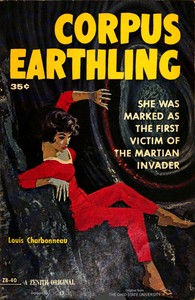
After finishing The Crystal Planetoids, I kept thinking about how quiet it feels when someone’s world narrows to a strange room. That same hush followed me through Corpus earthling — Story, Setting & Ideas, like remembering a dream where the walls breathe. It’s less a story than a weather pattern inside you, lingering gently.
There are no reviews for this eBook.
There are no comments for this eBook.
Reader reflection
What was your reading experience?
Capture what you thought, learned, and would like to remember.
Your progress
0
/
10
2
What was your overall reaction to the book?
3
Would you pass this book on to a friend?
4
How easy was the book to follow?
5
How did the reading compare with what you expected?
6
How original did the book feel?
7
Was the book easy to understand?
8
Did any part of the book stay with you emotionally?
9
What changed or sharpened your thinking?
10