
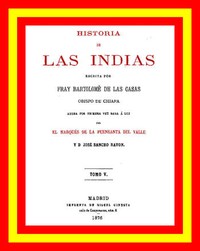
Historia de las Indias (vol. 5 de 5) by Bartolomé de las Casas
This fifth and final volume of Bartolomé de las Casas's monumental work isn't a simple chronicle of dates and battles. It's the culmination of a lifetime of witness and protest. Las Casas, who started as a settler and priest in the early 1500s, became the most famous and controversial defender of Indigenous rights in the Spanish Empire. Here, he brings his decades of research, personal experience, and moral outrage together.
The Story
The 'story' is the brutal reality of Spanish colonization in the Caribbean and the American mainland. Las Casas methodically records the establishment of settlements, the systems of forced labor like the encomienda, and the countless acts of violence against native populations. He names names, quotes laws, and describes scenes of suffering in stark detail. Interwoven with this grim record is his own life's journey: his debates with other colonists and theologians, his trips back to Spain to plead with the king, and his relentless push for laws that would protect people he saw being destroyed. The narrative tension comes from his struggle against a powerful economic and political machine that saw human beings as a resource.
Why You Should Read It
You should read this because it's a primary source with a pulse. This isn't a historian from our time analyzing the past; this is a man living through it, screaming from the page. His anger, his frustration, and his compassion are palpable. It forces you to confront the human cost of history head-on, without the softening filter of centuries. More than that, it's a powerful study of what it means to change your mind. Las Casas completely reversed his own early views, showing that moral courage can grow from recognizing your own complicity. It’s a difficult, often painful read, but it’s a crucial antidote to romanticized versions of the 'Age of Discovery.'
Final Verdict
This book is perfect for readers who want to go beyond textbook summaries and engage directly with a defining voice from a turbulent era. It's essential for anyone interested in colonial history, human rights, or the power of personal testimony. Be warned: it is dense and the language is of its time, so it requires some patience. But if you stick with it, you'll be rewarded with an unforgettable perspective from a man who refused to look away. Pair it with a modern historical analysis for context, but let Las Casas's own fiery voice speak to you directly.
This content is free to share and distribute. Thank you for supporting open literature.
Ashley Thomas
1 year agoI stumbled upon this title and the arguments are well-supported by credible references. Highly recommended.
Noah Clark
1 year agoMy professor recommended this, and I see why.
Daniel Brown
8 months agoFive stars!
Donald Lewis
8 months agoRead this on my tablet, looks great.






Mark Moore
1 year agoI didn't expect much, but the content flows smoothly from one chapter to the next. I would gladly recommend this title.