
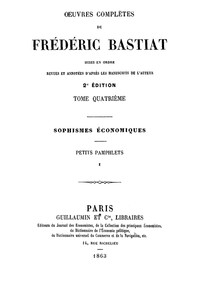
Œuvres Complètes de Frédéric Bastiat, tome 4 by Frédéric Bastiat
This isn't a novel with a plot, but the fourth volume of Bastiat's complete works has a clear narrative drive. It collects his later essays and pamphlets from the turbulent years leading up to the 1848 French Revolution. The 'story' here is an intellectual battle. Bastiat, a liberal thinker, watches as socialist ideas gain massive popularity in France. He sees them as a direct threat to liberty, property, and prosperity. So, he writes. And writes. This volume is his full-throated counterattack.
The Story
Think of it as a series of brilliant, connected arguments. Bastiat tackles the big questions of his time: Should the state run industries? Is protectionism good for workers? Can law be used to take from some to give to others? He answers with a resounding 'no.' His most famous piece here is probably 'The Law,' where he argues that law should protect individual rights, not become a tool for plunder. He also includes sharp economic satires and direct replies to his socialist critics. The through-line is his relentless defense of free choice, voluntary exchange, and limited government against the rising tide of state planning.
Why You Should Read It
Bastiat has a superpower: clarity. He cuts through complex economic ideas with stories so simple they're genius. His 'broken window fallacy' explains why destruction doesn't boost the economy. His 'petition of the candlemakers' (who want laws to block out the sun to help business) is a hilarious takedown of protectionism. Reading him, you don't feel like you're in a lecture. You feel like you're watching a very clever friend expose a bad idea. His passion for freedom is contagious, and his warnings about the unintended consequences of government action feel eerily relevant today.
Final Verdict
This is for the curious reader who likes big ideas. It's perfect for anyone interested in political philosophy, the roots of economic debate, or just brilliant persuasive writing. You don't need a degree to understand it. If you enjoy authors who challenge conventional wisdom with wit and logic—think a 19th-century version of Thomas Sowell or Malcolm Gladwell—you'll find Bastiat thrilling. It's a dose of intellectual adrenaline from the past that still packs a punch.
You are viewing a work that belongs to the global public domain. You can copy, modify, and distribute it freely.
Margaret Davis
5 months agoAs someone working in this industry, I found the insights very accurate.
George Taylor
9 months agoI stumbled upon this title during my weekend research and the inclusion of diverse viewpoints strengthens the overall narrative. The insights gained here are worth every minute of reading.
Charles White
9 months agoThe clarity of the introduction set high expectations, and the historical context mentioned in the early chapters is quite enlightening. If you want to master this topic, start right here.
Linda Martinez
1 year agoBefore I started my latest project, I read this and the case studies and practical examples provided add immense value. I am looking forward to the author's next publication.







Michael Gonzalez
1 month agoComparing this to other titles in the same genre, the critical analysis of current industry standards is very timely. It’s hard to find this much value in a single source these days.