
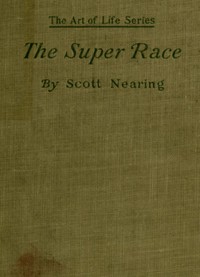
The Super Race: An American Problem by Scott Nearing
Let's set the scene: America in the early 1900s. The country is booming, immigrants are arriving in huge numbers, and there's a loud, influential group of thinkers, scientists, and politicians pushing a idea called eugenics. Their goal? To improve the human race by encouraging 'good' stock to have more children and discouraging or even preventing the 'unfit' from having any. Scott Nearing, a bold and controversial figure, wrote this book as a direct challenge to that entire movement.
The Story
This isn't a novel with characters; it's a forceful argument. Nearing lays out the core beliefs of the eugenicists—their fears about 'race degeneration,' their calls for immigration restrictions based on nationality, and their support for policies like forced sterilization. Then, piece by piece, he takes their logic apart. He argues that labeling entire groups of people as 'inferior' is not just cruel, but bad science. He questions who gets to decide what 'fitness' even means and points out how these ideas are often just masks for class prejudice and racism. The 'story' is the clash between a popular, rising ideology and one man's principled stand against it.
Why You Should Read It
Reading this book is like finding a clear, angry voice from the past shouting a warning we should have listened to better. It's deeply uncomfortable, because Nearing is describing the intellectual groundwork for atrocities that would happen later. What gets me is his focus on this being an American problem. He's arguing with his own countrymen about the soul of the nation. Is it built on an exclusive idea of 'blood,' or on something more democratic? His passion is palpable on every page. It makes you realize these debates about who belongs and who is 'worthy' aren't new; they just keep getting recycled.
Final Verdict
This book is perfect for readers who love history that isn't sugar-coated. It's for anyone interested in the roots of social policy, racial science, or immigration debates. It's also a tough read, I won't lie. The language is of its time, and the subject is heavy. But if you want to understand a dark undercurrent of American thought and see a brave example of someone speaking against the tide, it's absolutely worth your time. Don't read it for a feel-good story; read it to be challenged and to see how the arguments of the past still echo loudly today.
This masterpiece is free from copyright limitations. Share knowledge freely with the world.
Christopher Smith
2 years agoI've been looking for a reliable source on this topic, and the transition between theoretical knowledge and practical application is seamless. This should be on the reading list of every serious professional.
Emily Harris
1 year agoThis is now a staple reference in my professional collection.
Mary Perez
1 year agoUnlike many other resources I've purchased before, the nuanced approach to the central theme was better than I expected. A perfect balance of theory and practical advice.
Linda Thompson
1 week agoI appreciate the objective tone and the evidence-based approach.








John Miller
4 months agoI was skeptical about the depth of this book at first, but the transition between theoretical knowledge and practical application is seamless. I'm glad I chose this over the other alternatives.