
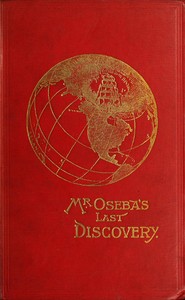
Mr. Oseba's Last Discovery by George W. Bell
George W. Bell's Mr. Oseba's Last Discovery is a forgotten gem from 1904 that masquerades as a simple adventure tale but packs a surprising punch. It's a short, peculiar book that feels both of its time and startlingly relevant.
The Story
The book is framed as a report. We learn about the final hours of the great explorer, Leo Oseba. On his deathbed, he gathers his followers for one last lecture. He tells them of his ultimate discovery: a passage to the interior of the Earth. There, in a land lit by a central sun, he found the nation of 'Symmes' Hole' (a playful nod to the real Hollow Earth theory of John Cleves Symmes). Oseba describes a technological utopia. They have flying machines, perfect weather control, and a society that has eliminated all the problems we face—war, crime, social inequality. The people are peaceful, educated, and live in harmony. The story is really Oseba's detailed account of this civilization's structure, achievements, and philosophy, presented as a final gift—or perhaps a challenge—to the surface world he is leaving behind.
Why You Should Read It
Don't let the 1904 publication date fool you. This isn't a dry, dusty tome. Bell's writing is clear and his ideas are big. The fun isn't in fancy prose, but in the sheer audacity of the concept. Reading it, you quickly realize the book is less about a hollow Earth and more about a hollowed-out critique of Bell's own society. Every perfect aspect of Symmes' Hole—from their government to their treatment of women—directly comments on the imperfections of the early 20th century. Oseba isn't just an explorer; he's a messenger. The book becomes a fascinating 'what if' game. What if we solved all our problems? What would that society even look like? It's a quick, imaginative read that makes you think without feeling like homework.
Final Verdict
This book is a perfect pick for readers who love early science fiction and social commentary. If you enjoy the utopian dreams of H.G. Wells or the satirical edge of Mark Twain, you'll find a kindred spirit in George W. Bell. It's also great for anyone interested in the weird history of ideas—like Hollow Earth theory—and how authors use wild settings to talk about real issues. Because it's short and the plot is straightforward, it's not a difficult read, just a thought-provoking one. Think of it as a fascinating historical artifact that still has something to say.
This title is part of the public domain archive. Access is open to everyone around the world.
Paul Martinez
5 months agoGiven the current trends in this field, the step-by-step breakdown of the methodology is extremely helpful for students. A mandatory read for anyone in this industry.
Linda Brown
4 months agoUnlike many other resources I've purchased before, the author clearly has a deep mastery of the subject matter. I feel much more confident in my knowledge after finishing this.
Donald Perez
6 months agoOne of the most comprehensive guides I've read this year.
Paul Martinez
11 months agoWhile browsing through various academic sources, the formatting on mobile devices is surprisingly crisp and clear. A trustworthy resource that I'll keep in my digital library.



Nancy Taylor
3 weeks agoBefore I started my latest project, I read this and the clarity of the writing makes even the most dense sections readable. If you want to master this topic, start right here.