
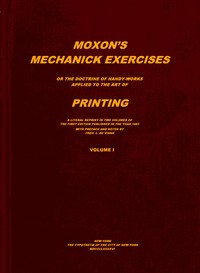
Moxon's mechanick exercises, volume 1 (of 2) : The doctrine of handy-works…
So, what's this book actually about? Don't let the formal title fool you. Moxon's Mechanick Exercises isn't a dry technical paper. Think of it as a time capsule, a series of incredibly detailed letters from a curious friend who visited every workshop in London and wrote down exactly what he saw.
The Story
There isn't a plot in the traditional sense. Instead, Joseph Moxon builds his world one tool and one technique at a time. He starts with the humble workbench, explaining why it must be sturdy and how to hold it down. Then, he walks you through every hand tool a joiner (a fine woodworker) would use: saws, planes, chisels, hammers. He doesn't just name them; he tells you how to sharpen them, why a bad one ruins your work, and how to use them properly. He moves on to the art of turning wood on a lathe, then into the fiery world of the smith, explaining how to forge iron and steel. It's a linear journey from the foundation of a craft to its finished products.
Why You Should Read It
This book hooked me because of Moxon's voice. He's not a detached professor; he's a hands-on guy who gets frustrated with blunt tools and takes pride in a well-set plane. His passion is contagious. Reading his instructions, you feel the satisfaction he gets from a perfect dovetail joint or a smoothly forged nail. It makes you appreciate the sheer intelligence embedded in pre-industrial craftsmanship. The real magic isn't in the objects themselves, but in the problem-solving—how to make a perfectly straight edge without a machine, or how to temper metal so it's hard but won't shatter. It's a profound look at how people thought and worked with their hands, long before power tools and factories.
Final Verdict
This is a niche read, but a deeply rewarding one. It's perfect for makers, history nerds, and anyone who's ever looked at an old chair and wondered, 'How did they do that?' If you love shows about forging or woodworking, this is the original source material. It's not a breezy novel—you have to want to geek out on the details. But if you do, it's like discovering a secret library of lost skills. You'll never see the physical world the same way again.
The copyright for this book has expired, making it public property. It serves as a testament to our shared literary heritage.
Ashley Williams
5 months agoI took detailed notes while reading through the chapters and the formatting on mobile devices is surprisingly crisp and clear. I'm genuinely impressed by the quality of this digital edition.
Richard Martin
3 months agoI decided to give this a try based on a colleague's recommendation, the breakdown of complex theories into digestible segments is masterfully done. A trustworthy resource that I'll keep in my digital library.
Charles Lopez
11 months agoLooking at the bibliography alone, the evidence-based approach makes it a very credible source of information. It’s hard to find this much value in a single source these days.
David Williams
8 months agoFinally found a version that is easy on the eyes.


Karen Moore
3 months agoHaving followed this topic for years, I can say that the attention to detail regarding the core terminology is flawless. I'll be recommending this to my students and colleagues alike.