
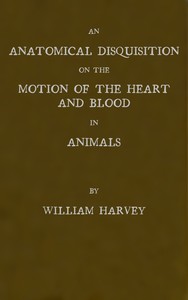
An anatomical disquisition on the motion of the heart & blood in animals by Harvey
Let's be clear: this isn't a novel with a plot. The 'story' here is the slow, methodical unraveling of a massive scientific mistake. William Harvey, physician to English kings, starts with a simple, heretical question: What if the ancient Roman doctor Galen, whose teachings ruled medicine for centuries, was wrong about blood?
The Story
Harvey walks us through his detective work. He didn't have high-tech tools; he had careful observation and logic. He tied off arteries and watched them swell on the heart's side. He calculated the sheer volume of blood pumped by the heart in an hour—it was more than a person's entire weight! The numbers didn't lie: blood couldn't be constantly made and consumed. It had to be reused. It had to go in a circle. Piece by piece, using demonstrations anyone could repeat (if they had the stomach for it), he built his case for circulation. The heart wasn't a warming organ; it was a muscular pump. Blood raced away from it in arteries and returned via veins, a closed loop serving the whole body. Publishing this in 1628 was like shouting that the Earth wasn't the center of the universe. He was challenging the entire medical establishment.
Why You Should Read It
You should read it to feel the raw excitement of a foundational truth being uncovered. Harvey's voice is surprisingly direct. You can feel his frustration with blind followers of tradition and his pride in his painstaking proofs. It’s a masterclass in clear scientific thinking. Reading it, you don't just learn a fact; you witness the moment humanity finally understood the engine inside our chests. It makes you appreciate the courage it takes to say, 'I have looked, and the old story doesn't fit what I see.'
Final Verdict
Perfect for curious minds who love history, science, or a great underdog story. If you've ever enjoyed a medical drama or wondered how we figured out the basics of our own bodies, give this a try. It's not a light read—the 17th-century prose takes some getting used to—but it's short, focused, and profoundly rewarding. You'll never feel your own pulse the same way again.
Anthony Anderson
1 year agoBased on the summary, I decided to read it and it challenges the reader's perspective in an intellectual way. Worth every second.
Mark Williams
4 months agoI had low expectations initially, however the arguments are well-supported by credible references. Truly inspiring.
Jessica Rodriguez
1 year agoSurprisingly enough, the depth of research presented here is truly commendable. Worth every second.
Mason Moore
1 year agoGreat read!






Linda Williams
8 months agoI stumbled upon this title and it creates a vivid world that you simply do not want to leave. One of the best books I've read this year.